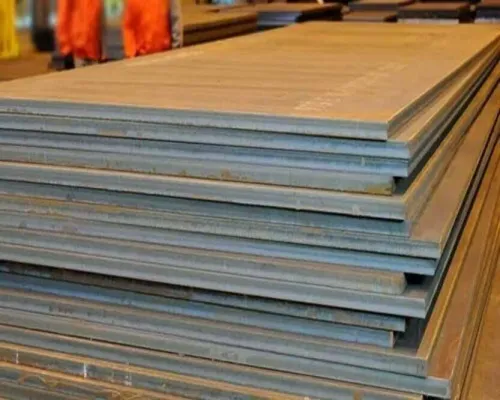


A quotation for SA387 plate is incomplete until it states the grade, class, thickness, heat-treatment condition and governing specification. You will be able to distinguish Grade 11 from Grade 22, decode Class 1 and Class 2, and check whether an Indian stockist has supplied traceable pressure-vessel material.
Key takeaways
- Specify both the SA387 grade and class on every quotation request.
- Choose Grade 11 or 22 from chromium-molybdenum service requirements.
- Treat Class 1 and Class 2 as separate strength requirements.
- Request the MTC, heat number and applicable inspection records.
Decode the SA387 designation before requesting a quotation
SA387/A387 separates the alloy grade from the strength class. Grade 11 and Grade 22 have different chromium-molybdenum chemistries; Class 1 and Class 2 mainly identify different mechanical-strength requirements within the same grade. Omitting the class leaves the required strength unresolved, even when the chemistry is unchanged.
“SA387 Gr 1 by 2” is not a usable purchase designation. It could mean Grade 1 and Grade 2, Class 1 and Class 2, or a 1/2-inch plate thickness. A search for “sa387 gr 1 by 2 steel plates stockist in india” does not remove that ambiguity.
Write the complete designation before requesting a quotation:
- SA-387 Grade 11 Class 1
- SA-387 Grade 11 Class 2
- SA-387 Grade 22 Class 2
Grade 11 and Grade 22 are different sa387 alloy steel plate grades, not interchangeable labels. Grade 11 belongs to the approximate 1.25% chromium–0.5% molybdenum family, while Grade 22 belongs to the approximate 2.25% chromium–1% molybdenum family; confirm the permitted chemistry on the applicable specification and heat-specific mill test certificate.
SA387 covers chromium-molybdenum alloy-steel plates for welded boilers and pressure vessels. It is low-alloy pressure-vessel steel, not stainless steel, despite its chromium content. Ask for the grade, class, thickness and governing ASTM A387/A387M or ASME SA387/SA387M designation together.
Grade 11 versus Grade 22: chemistry and service selection
Grade 11 and Grade 22 are not interchangeable: their chromium-molybdenum levels determine the service assessment, fabrication procedure and equipment specification.
| Element | Grade 11, wt% | Grade 22, wt% |
|---|---|---|
| Carbon | 0.05–0.17 | 0.05–0.15 |
| Manganese | 0.30–0.60 | 0.30–0.60 |
| Phosphorus, maximum | 0.035 | 0.035 |
| Sulfur, maximum | 0.035 | 0.035 |
| Silicon, maximum | 0.50 | 0.50 |
| Chromium | 1.00–1.50 | 1.90–2.60 |
| Molybdenum | 0.44–0.65 | 0.87–1.13 |
Confirm these limits against the ordered ASTM A387/A387M or ASME SA387/SA387M edition and the heat-specific mill test certificate (MTC). The nominal families are approximately 1.25% chromium–0.5% molybdenum for Grade 11 and 2.25% chromium–1% molybdenum for Grade 22.
Grade 22’s higher chromium and molybdenum support improved resistance in elevated-temperature, hydrogen-containing and corrosive refinery or power-service environments. That does not make it a universal upgrade: select the grade from the design code, operating temperature, pressure, process medium and equipment specification.
SA387 is low-alloy pressure-vessel steel, not stainless steel, despite its chromium content. A buyer comparing sa387 alloy steel plate grades, or searching for a sa387 grade 22 cl2 plates stockist, must verify the specified grade and heat rather than rely on nominal chemistry or a stockist’s description.
Class 1 and Class 2: compare the strength requirements
Class 2 raises the minimum tensile and yield strengths; the chemistry remains the same within each grade. The base mechanical values for plate up to 2.5 in (65 mm) are:
| Grade and class | Minimum tensile strength | Minimum yield strength | Minimum elongation |
|---|---|---|---|
| SA387 Grade 11 Class 1 | 60 ksi (415 MPa); range 60–80 ksi (415–550 MPa) | 32 ksi (220 MPa) | 25% in 8 in (200 mm); 21% in 2 in (50 mm) |
| SA387 Grade 11 Class 2 | 70 ksi (485 MPa); range 70–90 ksi (485–620 MPa) | 40 ksi (275 MPa) | 21% in 8 in (200 mm); 18% in 2 in (50 mm) |
| SA387 Grade 22 Class 1 | 60 ksi (415 MPa); range 60–80 ksi (415–550 MPa) | 32 ksi (220 MPa) | 25% in 8 in (200 mm); 21% in 2 in (50 mm) |
| SA387 Grade 22 Class 2 | 70 ksi (485 MPa); range 70–90 ksi (485–620 MPa) | 40 ksi (275 MPa) | 21% in 8 in (200 mm); 18% in 2 in (50 mm) |
For plate above the table’s thickness range, apply the edition’s thickness-specific elongation rules and test method.
Nominal thickness matters because it determines which requirement applies; do not approve SA387 Grade 11 Class 1 plates in India against a Class 2 requirement, or treat SA387 Grade 11 Class 2 plates in India as interchangeable without design-authority approval.
Order normalized and tempered, or quenched and tempered, when the specification and purchase order require that condition. Demand the actual heat-treatment condition and heat number on the MTC, then match them to the plate marking. A quotation or invoice that adds the grade after supply is not evidence of compliance.
ASTM A387, ASME SA387 and the documents a pressure-vessel buyer needs
ASTM A387/A387M names the ASTM material specification; SA387/SA387M identifies the ASME-adopted specification context under Section II, Part A. Write the ASME designation into the purchase order when the plate enters equipment built to the ASME Boiler and Pressure Vessel Code or when the design authority requires ASME material acceptance.
1. State the complete designation, thickness and required edition: ASTM A387/A387M or ASME SA387/SA387M, Grade 11 or Grade 22, Class 1 or Class 2. A search phrase such as “sa387 grade 11 cl1 plates india” does not replace those purchase-order details; neither does “sa387 grade 11 cl2 plates india.”
2. Request the material test certificate showing the specification and edition, grade, class, heat number, chemical analysis, heat treatment, tensile strength, yield strength, elongation, dimensions and plate marking. An ASTM certificate alone does not automatically satisfy ASME fabrication, inspection, authorised-inspection or certification obligations.
3. Cite ASTM A20/A20M for general pressure-vessel plate requirements, including dimensions, thickness tolerances, marking, sampling, retesting and certification. Specify the A20/A20M edition and tolerance basis; nominal thickness alone is insufficient.
4. Add Charpy impact testing only when the design temperature, governing code or equipment specification requires it. State the test temperature and require the results on the certificate or supplementary report: Grade 11 or Grade 22 alone does not establish impact toughness. Keep the certificate matched to the heat number through cutting or plate splitting.
How to evaluate an SA387 stockist in India before purchase
A credible quotation resolves material identity before it discusses availability. Reject “SA387 Gr 1 by 2” until the seller states whether it means Grade 11 or 22, Class 1 or 2, or 1/2-inch thickness; a search phrase such as “sa387 gr 1 by 2 steel plates stockist in india” is not a purchase specification.
Request these fields in writing:
- Complete grade and class; ASTM A387/A387M or ASME SA387/SA387M designation and edition
- Thickness, width, length, quantity, delivery form and acceptable substitutions
- ASTM A20/A20M edition and tolerance basis
- Normalized-and-tempered or quenched-and-tempered condition
- Charpy impact-test requirement and inspection level, including witness or hold points
| Receiving check | Acceptance action |
|---|---|
| Plate identity | Match marking, heat number, grade, class and dimensions to the purchase order |
| MTC chemistry | Verify carbon, manganese, phosphorus, sulfur, silicon, chromium and molybdenum |
| MTC mechanics | Verify tensile strength, yield strength, elongation and thickness basis |
| Traceability | Transfer the heat number to every piece after cutting or plate splitting |
| Heat treatment | Match the certified condition and heat number; investigate missing records |
An MTC that does not match the plate marking is a stop signal, not a paperwork defect. A generic ready-stock claim from an sa387 grade 22 cl2 plates stockist proves nothing.
Before fabrication, require a qualified welding procedure controlling preheat, interpass temperature, hydrogen exposure, consumables and post-weld heat treatment. The stockist’s grade name cannot replace that procedure.
Shyam Metals & Alloys is one sourcing option: ask it to document grade, class, dimensions, heat number and MTC, then have your inspection team verify them rather than accepting “ready stock” as compliance.
Related products
 | Alloy Steel Plate Grades View product → |
 | Alloy Steel Plate Grades View product → |
Frequently asked questions
What do Grade 11, Grade 22, Class 1 and Class 2 mean in SA387 plates?
Grade 11 and Grade 22 identify different chromium-molybdenum chemistries. Class 1 and Class 2 identify different mechanical-strength requirements within each grade.
How do SA387 Grade 11 and Grade 22 differ?
Grade 11 is a chromium-molybdenum pressure-vessel steel with lower alloy content than Grade 22. Select between them using the vessel design, temperature, corrosion and hydrogen-service requirements.
Is SA387 Class 2 stronger than Class 1?
Class 1 and Class 2 have different tensile and yield-strength requirements. Confirm the exact minimum values in the current ASTM A387 or ASME SA387 specification and order the required class explicitly.
Which documents should you request from an SA387 stockist in India?
Request a material test certificate showing SA387 grade, class, heat number, plate size, chemistry and mechanical results. Add the purchase specification, inspection plan, supplementary testing and traceability records when the project requires them.
Related products
 | Alloy Steel Plate Grades View product → |
 | Alloy Steel Plate Grades View product → |
 | Alloy Steel Plate Grades View product → |
 | Alloy Steel Plate Grades View product → |