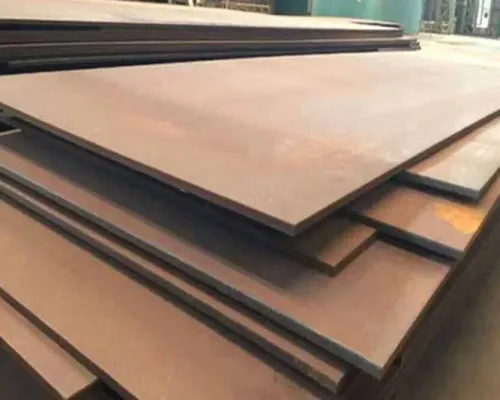


A quotation for SA387 Grade 9 Class 1 is incomplete until it identifies the governing edition, mechanical class, dimensions, heat treatment, inspection scope, and certificate trail. By the end, you will be able to compare Indian manufacturer and stockist offers against the material specification and confirm whether the delivered plate is suitable for pressure-vessel fabrication.
Key takeaways
- Confirm ASME SA387, Grade 9, Class 1, thickness, dimensions, and delivery condition.
- Ask for the heat number, MTC, test results, and traceability before accepting plates.
- Compare quotations by chemistry, testing, tolerances, cutting, certification, and delivery—not price alone.
- Reject plates with missing markings, damaged surfaces, inconsistent dimensions, or incomplete documentation.
What SA387 Grade 9 Class 1 is designed to handle
SA-387 Grade 9 Class 1 is a chromium-molybdenum pressure-vessel plate for welded boilers, refinery equipment, petrochemical vessels, and other elevated-temperature service. It is selected where carbon steel lacks the required resistance to heat and oxidation, while the vessel still requires a weldable plate grade.
Its nominal 9Cr-1Mo chemistry contains carbon up to about 0.15%, manganese about 0.30–0.60%, silicon up to 0.50%, chromium about 8.00–10.00%, and molybdenum about 0.90–1.10%. Confirm the phosphorus and sulfur limits against the ordered edition of ASTM A387/A387M or ASME SA-387/SA-387M, because edition-specific limits govern acceptance.
Chromium improves oxidation resistance; molybdenum supports high-temperature strength and increases hardenability.
Before accepting SA 387 Grade 9 Cl 1 plates, check these points:
- Confirm the marking and mill certificate identify SA-387 Grade 9, Class 1, the governing specification edition, heat number, and ordered heat-treatment condition.
- Compare the reported chemistry with the ordered edition, including carbon, manganese, silicon, chromium, molybdenum, phosphorus, and sulfur.
- Do not substitute P91 or T91, or accept Grade 9 as equivalent. P91 and T91 include controlled additions of vanadium, niobium, nitrogen, and related chemistry that Grade 9 does not have; Class 1 describes the specified property class, not that alloy system.
How the standard, class, and thickness change acceptance
Acceptance changes with the specification edition, class, and ordered thickness; “SA 387 Grade 9 Class 1” alone is not a complete acceptance basis. ASTM A387/A387M is the ASTM specification, while ASME SA-387/SA-387M is the ASME adoption used in many Indian quotations.
1. Name the governing code edition on the purchase order, such as the specified ASTM A387/A387M or ASME SA-387/SA-387M edition. Also identify the applicable ASTM A20/A20M general-requirements edition, because that document controls shared requirements for dimensions, testing, tolerances, and certification.
2. Treat Class 1 as a mechanical-property class, not a thickness class or heat-treatment designation. The commonly specified Grade 9 Class 1 minimum yield strength is approximately 310 MPa, tensile strength is 515–690 MPa, and elongation is 18%; Class 2 carries higher strength requirements.
3. Require the supplier to state the exact yield, tensile, and elongation limits for every ordered thickness, together with the test conditions. Acceptance values and test conditions vary with thickness, so do not copy one strength table across all sizes.
4. Compare the specified limits directly with the mill test certificate for the heat and plate supplied. Do not treat Class 2 as a universal quality ranking: it indicates a different mechanical-property requirement, not automatically better steel, cleaner material, or superior service performance.
For sa 387 grade 9 cl 1 plates, the order should therefore state the designation, edition, A20/A20M edition, thickness, and applicable property limits before a quotation is accepted.
How to choose the grade and define the plate before fabrication
Choose Grade 9 only when the design temperature, oxidation or corrosion environment, strength calculation, weld procedure, and governing vessel code all support its 9Cr-1Mo chemistry. The drawing and construction code control the material; a supplier’s substitute grade does not.
| Option | Selection test | Main trade-off |
|---|---|---|
| Grade 9 | Elevated-temperature pressure service needs stronger oxidation resistance than carbon steel and higher Cr-Mo performance; code permits A387/SA-387. | More chromium and molybdenum raise cost and demand controlled welding. |
| Grade 11 or 12 | The code and design calculation accept their lower alloy content and service capability. | They are not interchangeable with Grade 9. |
| Grade 5 | The code specifically calls for higher chromium in a corrosion or oxidation environment. | Higher alloy cost and welding controls remain necessary. |
| Carbon steel | Temperature, oxidation exposure, strength, and code permit plain carbon steel. | It may lose strength or oxidize too quickly at elevated temperature. |
| Stainless steel | The environment requires stainless corrosion resistance that Cr-Mo pressure plate cannot provide. | Higher material cost and different welding, strength, and code rules. |
Put these details on the order:
- Nominal thickness, width, length, quantity, full plates or cut-to-size blanks
- A20/A20M dimensional tolerances, required flatness, edge condition, and surface condition
- ASTM A387/A387M or ASME SA-387/SA-387M designation, governing editions, Class 1, marking, tests, and certificate requirements
Specify normalized and tempered supply as the normal route. Request annealed material only where the specification and construction code permit it, and require the mill certificate to state the actual treatment. Before fabrication, qualify a Cr-Mo WPS/PQR covering preheat, interpass temperature, hydrogen control, consumable classification, weld-metal chemistry, and PWHT.
How an Indian manufacturer or stockist turns the specification into a quotation
A quotation cannot be priced from “SA 387 Gr 9 Cl 1” alone. An alloy steel plates manufacturer in India or alloy steel plates supplier in India needs the complete order data:
- Grade 9, Class 1; thickness, width, length, and quantity
- Delivery location and required dispatch date
- ASTM A387/A387M or ASME SA-387/SA-387M designation, including edition
- Normalized-and-tempered or permitted annealed condition
- Surface finish, flatness, edge condition, and full plate or cut-to-size supply
- Marking method, supplementary tests such as ultrasonic examination, and certificate level, including EN 10204 Type 3.1 or 3.2
The commercial role affects what you receive.
| Role | Records and supply position | Question to ask |
|---|---|---|
| Rolling mill | Created the heat, rolling, heat-treatment, and original MTC records | Which mill produced this heat? |
| Alloy steel plates stockist in India | Holds imported or domestic plate and may cut it to size | Can you provide the original MTC and traceability after cutting? |
Shyam Metals & Alloys can be evaluated as one Indian supply option by asking for the actual producer, available dimensions, lead time, original MTC, and cut-piece traceability. Do not accept “available” without evidence.
For cut blanks, require heat-number transfer onto every piece, a cut-piece map, and preservation of the original certificate. A stockist’s name is not the steelmaker’s name, and a replacement certificate is not proof that the delivered plate came from the quoted heat.
Related product
Alloy Steel Plate Grades View product → |
How to verify the delivered plates and compare competing offers
Quarantine a plate if its marking cannot be tied to the mill test certificate (MTC). An alloy steel plates supplier in India should provide a certificate that follows the delivered material back to its heat, rolling records, and heat-treatment records.
- Match the plate marking with the MTC for heat number, ASTM A387/A387M or ASME SA-387/SA-387M specification, Grade 9, Class 1, dimensions, and heat-treatment condition.
- Check the reported chemistry, yield test, tensile test, elongation, and every ordered NDE against the purchase order. SA387 Grade 9 Class 1 does not automatically include straight-beam ultrasonic testing; state ASTM A578/A578M, scan coverage, and acceptance level explicitly.
- Require an EN 10204 Type 3.1 document for manufacturer inspection results on the supplied product. Specify Type 3.2 when purchaser or designated inspector validation is required.
- For cut plates, require heat-number transfer on every piece, a cut-piece map, and preservation of the original certificate. An alloy steel plates stockist in India must not leave traceability dependent on a removed plate stencil.
Compare offers on technical completeness before comparing price per kilogram.
| Offer | What to verify | Commercial risk |
|---|---|---|
| Complete | Grade, Class 1, dimensions, treatment, chemistry, tests, NDE, certificate type, and traceability stated | Lowest ambiguity |
| Generic | “SA387 Grade 9 Class 1” with no coverage, acceptance level, or certificate type | Hidden inspection gaps |
| Cut-to-size | Piece markings, cut map, original MTC, and producer identified | Lost heat traceability |
Frequently asked questions
What is SA387 Grade 9 Class 1 plate designed to handle?
It is a chromium-molybdenum pressure-vessel plate for welded boilers, refinery equipment, petrochemical vessels, and elevated-temperature service where carbon steel lacks sufficient heat and oxidation resistance.
How do the standard, class, and thickness affect plate acceptance?
ASME SA387 identifies the pressure-vessel plate specification, Grade 9 identifies the chromium-molybdenum composition, and Class 1 identifies the required tensile and yield strength category. Thickness affects mechanical-property requirements, inspection, fabrication, and the applicable dimensional tolerances.
What information should you define before requesting a quotation?
State SA387 Grade 9 Class 1, required thickness, width, length, quantity, permitted substitutions, delivery condition, inspection requirements, testing, certification, marking, cutting, and delivery location.
How can you verify delivered SA387 Grade 9 Class 1 plates?
Match the plate marking and heat number to the mill test certificate, check chemistry and mechanical results, measure dimensions and thickness, inspect the surface, and confirm the ordered standard, grade, class, and quantity.
How should you compare offers from an Indian manufacturer, supplier, or stockist?
Compare the complete delivered specification, mill source, heat traceability, test certificates, inspection scope, plate condition, cutting tolerances, packing, lead time, freight, taxes, and replacement terms alongside the quoted price.