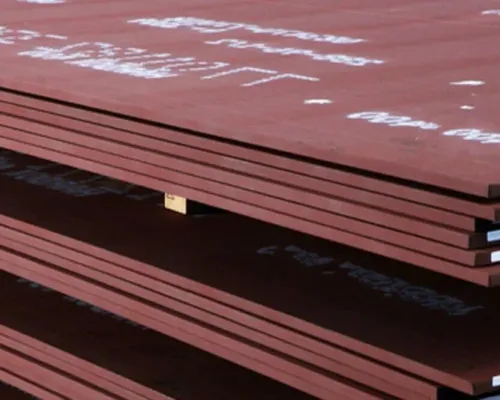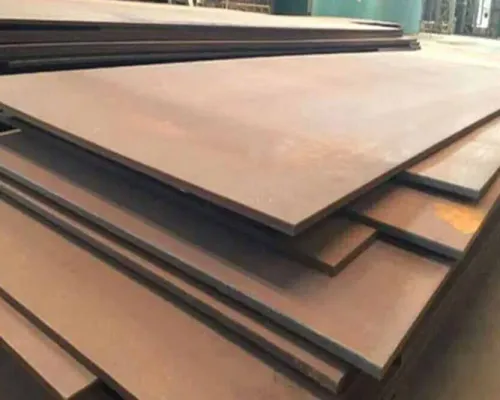

A plate marked S690QL is not automatically approved for every oil-and-gas duty: you must verify the EN 10025-6 grade, thickness-dependent strength, Charpy result, heat treatment and service requirements. By the end, you will know how to screen certificates, select realistic plate sizes, separate structural uses from pressure or sour service, and compare an Indian stockist’s supply capability.
Key takeaways
- Match plate markings, heat numbers and EN 10204 certification.
- Use S690QL for high-strength structures, not every pressure or sour-service duty.
- Specify thickness, dimensions, cutting method and fabrication controls before ordering.
- Compare stockists on traceability, certification, testing and cut-plate handling.
How to verify that the plate is genuinely EN 10025-6 S690QL
Accept the plate only when its marking, EN 10204 certificate and heat traceability identify EN 10025-6 S690QL—not S690QL1, S890QL or an unspecified “equivalent.” An S690QL high tensile steel plate supplier in India must link every plate or cut piece to its heat number; request Type 3.1 certification, or Type 3.2 when independent validation is required.
1. Confirm the delivery condition. S690QL is quenched and tempered fine-grain structural steel: “S” means structural, “690” the nominal yield-strength class, “Q” quenched and tempered, and “L” Charpy impact tested at −40 °C. Check the plate marking, heat number, certificate and thickness.
2. Compare the certificate’s product-analysis chemistry with the EN 10025-6 limits: carbon ≤0.20%, silicon ≤0.80%, manganese ≤1.70%, phosphorus ≤0.025%, sulphur ≤0.015%, chromium ≤1.50%, molybdenum ≤0.70%, nickel ≤2.00%, copper ≤0.50%, vanadium ≤0.12%, niobium ≤0.07%, titanium ≤0.05%, boron ≤0.005% and nitrogen ≤0.015%. Check the stated carbon equivalent too.
3. Require thickness-specific mechanical results. Up to 50 mm, require at least 690 MPa yield strength, 770–940 MPa tensile strength and 14% elongation; require Charpy V-notch energy of 30 J minimum at −40 °C. Do not accept “690 MPa” without the tested thickness.
4. Reject a generic grade claim for pressure service. EN 10025-6 is structural steel, not an automatic substitute for EN 10028-3, ASTM A516/A516M, ASME Section VIII or NACE MR0175/ISO 15156 requirements.
Which oil-and-gas applications suit S690QL—and which require another grade
Use S690QL for load-bearing steelwork, not automatically for anything that contains oil, gas or pressure. Its strongest case is reducing weight in pipe-rack frames, equipment skids, crane structures, offshore structural members, transport frames and high-load supports.
These are typical s690ql steel plate applications when the project accepts EN 10025-6 structural steel and the design verifies strength, toughness, fatigue and weldability.
| Application | S690QL position | What takes priority |
|---|---|---|
| Structural supports, skids and frames | Suitable when the design requires high yield strength and lower weight | Project requirements for fracture toughness, fatigue, fire performance, welding and offshore qualification |
| Pressure vessels, process drums and pressure-retaining headers | Do not approve it from the S690QL designation alone | The applicable pressure-vessel code, such as EN 10028-3, ASTM A516/A516M or ASME Section VIII, plus the equipment specification |
| Sour, hydrogen or severe-wear service | Treat suitability as unproven | NACE MR0175/ISO 15156 where applicable, hydrogen-service requirements, or a specified wear-resistant grade and abrasion test |
For H₂S-containing service, confirm hardness limits, environmental cracking resistance, testing and material approval before ordering. A pressure boundary also needs code-listed material compliance, not merely a 690 MPa yield-strength class.
Choose a wear-resistant plate when sliding abrasion, impact or erosive flow controls the design; high tensile strength alone does not provide the required wear performance. For restrained welded structures, require a qualified WPS and specify heat input, preheat, interpass temperature and low-hydrogen consumables, because excessive welding heat can reduce local toughness or strength.
How to choose S690QL plate thickness, size and fabrication controls
Select thickness from the governing failure mode, then add corrosion allowance and check what the mill can actually supply. A thinner plate reduces weight, but inadequate thickness increases buckling risk, weld distortion and fatigue stress at openings or attachments.
For sections up to 50 mm, S690QL has a 690 MPa minimum yield strength; above that, the specified yield value decreases, so do not apply 690 MPa to every thickness.
| Design or supply factor | What to specify | Why it matters |
|---|---|---|
| Static load and buckling | Calculated thickness, unsupported length and stiffener spacing | Buckling can govern before yield strength |
| Fatigue | Weld detail category, stress range and cycle count | High strength does not automatically improve welded-joint fatigue life |
| Corrosion | Design corrosion allowance and remaining-life target | Ordering only the net thickness can shorten service life |
| Dimensions | Width, length, flatness, tolerances and mill or cut plate | S690QL plate sizes depend on inventory, not the grade name |
| Fabrication | Cut-edge condition, bend radius and qualified welding procedure | Hard cut edges, tight bends or uncontrolled heat input can cause cracking |
Ask for the mill’s minimum cold-bending radius, preheat and interpass limits, heat-input guidance, and any post-cut hardness or visual inspection. Thermal-cut edges on critical welded parts may need grinding or testing; a cut-to-size service does not prove fabrication suitability.
State whether you need full-area ultrasonic testing to EN 10160, including its acceptance class, around cut-outs, or on finished welds. Confirm that the offered width and length meet the drawing after trimming, and obtain approval before substituting a stock size that changes weld locations or stiffener spacing.
What sour-service and pressure-service checks belong in the purchase enquiry
Do not approve S690QL for a pressure boundary merely because its nominal yield strength is 690 MPa. Its structural designation and EN 10025-6 certificate do not replace the governing pressure code, sour-service specification or hydrogen-compatibility assessment. S690QL steel plate applications near process equipment need written design approval.
| Service | Confirm before ordering | What can disqualify the plate |
|---|---|---|
| Pressure-containing equipment | EN 10028-3, ASTM A516/A516M or the specified code, plus ASME Section VIII design and material acceptance requirements | A structural-only certificate or no code acceptance |
| Wet H₂S service | NACE MR0175/ISO 15156 where its scope applies; specify hardness, weld qualification, environmental limits and cracking controls | No sour-service approval, hardness data or environmental definition |
| Hydrogen service | The project hydrogen-material specification, pressure code, fracture-toughness requirements and compatibility assessment for hydrogen exposure | Treating S690QL’s high strength as proof of hydrogen suitability |
Put these requirements in the enquiry:
- State EN 10025-6 S690QL, not S690QL1 or S890QL, and require heat-number traceability from every plate or cut piece to an EN 10204 Type 3.1 certificate; request Type 3.2 when an independent inspector must validate results.
- Specify Charpy V-notch energy at −40 °C, chemistry, yield, tensile and elongation values, plus hardness where sour service requires it.
- Specify full-area or local ultrasonic testing to EN 10160, including the acceptance class.
- Require a qualified WPS and procedure test to ISO 15614-1 or ASME Section IX, with preheat, interpass temperature, heat input and low-hydrogen consumables stated.
How to compare an S690QL stockist in India before ordering cut plate
A generic “S690QL” quote proves almost nothing. A credible S690QL plate stockist in India will identify the producing mill, heat number, thickness, delivery condition and inspection certificate for every plate or cut piece.
| Check | Traceable supply | Weak grade claim |
|---|---|---|
| Heat traceability | Plate marking and cut-piece records link to an EN 10204 Type 3.1 certificate; Type 3.2 is available when independent validation is specified | Certificate states only “S690QL” without heat identification |
| Mechanical data | Values match the quoted thickness, including yield strength, tensile strength, elongation and Charpy V-notch impact energy | 690 MPa is advertised for every thickness |
| Cutting | Supplier states thermal-cutting controls, edge hardness checks and inspection requirements | Cut-to-size service is treated as proof of fabrication readiness |
| Documentation | Mill certificate, heat-treatment condition, dimensions, tolerances and cut plan are supplied before release | PMI is offered as a substitute for testing and certification |
Your enquiry for S690QL high tensile steel plate for stockist in India should also reject “equivalent to S690QL” unless chemistry, impact testing, mechanical values and design acceptance are compared in writing. A stockist can supply mill plate without being the manufacturer, but cannot alter its grade or heat treatment without documented reprocessing and retesting.
Ask Shyam Metals & Alloys to state whether the quote covers mill plate or profiled plate, then confirm minimum bend radius, cut-edge condition, flatness and preservation requirements. Lose the original heat marking during cutting and traceability becomes a paperwork problem, not a cutting convenience.
Related products
 | Alloy Steel Plate Grades View product → |
High Tensile Plates High Tensile Plates En10028 S690Ql View product → |
Frequently asked questions
How do you verify that a plate is genuinely EN 10025-6 S690QL?
Check the plate marking, heat number and EN 10204 certificate. Require Type 3.1 certification, or Type 3.2 when independent validation is required, and ensure each cut piece remains linked to its original heat.
Which oil-and-gas applications suit S690QL steel plate?
S690QL suits high-strength structural parts, supports, skids, frames and heavy equipment where its strength-to-weight advantage matters. Confirm another grade when the service requires sour-service resistance, pressure-vessel approval, low-temperature toughness or a specified corrosion standard.
How should you choose S690QL plate thickness and size?
Set thickness from design loads, buckling, fatigue, weld details and the required toughness at service temperature. Confirm available S690QL plate sizes, cutting allowances, flatness and delivery dimensions before ordering.
What sour-service and pressure-service checks belong in the enquiry?
State the service fluid, hydrogen sulfide exposure, design temperature, pressure, applicable project specification and required tests. Ask whether the plate meets the specified sour-service or pressure-equipment standard instead of accepting an unspecified equivalent.
How can you compare an S690QL plate stockist in India before ordering cut plate?
Compare heat traceability, EN 10204 documentation, original mill certificates, testing scope, cutting tolerances, edge condition, packing, lead time and replacement procedures for nonconforming material.
Related product
High Strength Plates View product → |