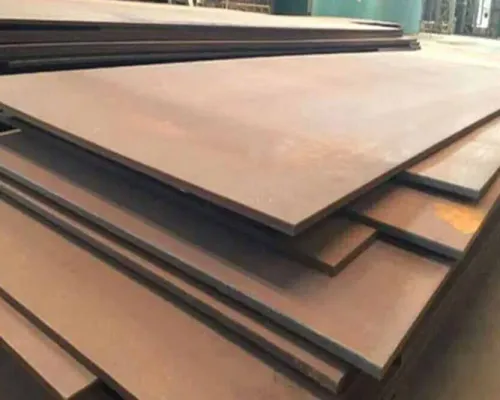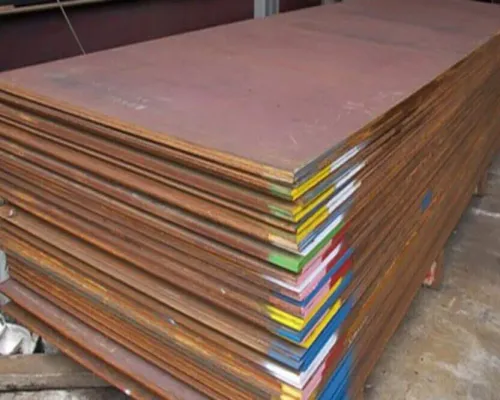

A nominal 400 HBW wear plate can extend the life of a slurry chute, mud-system liner or sand-handling hopper, but hardness alone does not prove that it suits the service. You will be able to match the plate to the wear mechanism, separate abrasion protection from corrosion and pressure qualification, and verify whether an Indian seller supplied genuine mill material or only processed stock.
Key takeaways
- 400 HBW indicates hardness, not a guaranteed service life.
- Match plate thickness and hardness to particle size, impact and support.
- Compare Hardox 400 with AR grades, liners and clad materials by failure mode.
- Request heat certificates, hardness results, dimensions and processing records before purchase.
What 400 HBW means when you select a wear plate
400 HBW is a nominal Brinell hardness class, not a guaranteed service-life number. Hardox 400 is a branded quenched-and-tempered abrasion-resistant steel, normally certified around 370–430 HBW. Its hardox 400 plate benefits are a practical balance of sliding-abrasion resistance, impact tolerance and fabricability; particle size, impact energy, plate support and operating geometry still control actual life.
| Option | What it means in service | Main trade-off |
|---|---|---|
| Hardox 400 | Balanced resistance for sliding and impact abrasion | Easier to form and weld than harder grades, but less wear resistance in severe sliding |
| Hardox 450 | Higher hardness for more demanding abrasive contact | More forming force, springback and fabrication control |
| Hardox 500 | Highest hardness of these choices for severe sliding wear | Toughness, forming and welding demands require closer design and process control |
| Ordinary structural steel | Lower hardness and usually faster loss of thickness under abrasion | Easier, cheaper fabrication, but more frequent replacement or thicker sacrificial sections |
Choose Hardox 400 when impact and abrasion occur together, rather than selecting the hardest plate automatically. Hardox 450 or 500 can extend life in predominantly sliding abrasion, but a hard plate can fail prematurely if impact, poor support or concentrated loading dominates.
None of these grades provides corrosion resistance: produced water, chlorides, acidic fluids or wet H₂S can require coating, corrosion allowance, cladding or a separate corrosion-resistant material.
Where Hardox 400 fits in oil-and-gas solids handling
Hardox 400 fits as a replaceable liner where abrasive solids cause sliding wear, impact abrasion, or both. For buyers assessing hardox wear plates for oil and gas, the strongest candidates are equipment surfaces exposed to sand, drilled cuttings, ore-like particles, or proppant, with sound plate support behind the liner.
| Location | What wears | When Hardox 400 fits |
|---|---|---|
| Chute and transfer point | Sliding solids with repeated impact at the loading edge | Use it when particle impact is moderate and the plate is continuously supported |
| Hopper, bin or skip | Falling and sliding sand, cuttings or bulk solids | Use it when abrasion controls liner replacement and shell pressure is carried separately |
| Mud or cuttings-handling equipment | Wet cuttings and abrasive solids across screens, conveyors or troughs | Use it when solids contact dominates; check corrosion separately |
| Sand-handling conveyor | Sliding sand at the belt transfer, skirt or discharge zone | Use it when high sliding distance drives wear and the liner can be replaced |
| Separator or desander internals | Localised particle impingement and flow turbulence | Use it after checking temperature, geometry and attachment details |
Choose Hardox 400 when the application provides:
- Abrasive particles large enough to cause measurable liner loss, but impact energy is not severe enough to demand a tougher design.
- Adequate backing, close fastener spacing or continuous weld support; unsupported plate flexing accelerates cracking and loosening.
- A replaceable wear surface rather than a pressure boundary.
Do not treat it as corrosion-resistant alloy steel. Produced water, chlorides, acidic fluids and wet H₂S require a separate corrosion and sour-service assessment. It is not automatically API 5L pipe, API 5CT tubular material or an ASME pressure-vessel material.
How to compare Hardox 400 with liners, AR grades and clad materials
Choose the material by failure mode, not hardness alone. Sliding abrasion favours Hardox 400, while severe impact may reward its toughness over a harder AR 450 or AR 500 grade. Particle size, impact energy, support, geometry and temperature determine wear life; hardness is not a wear calculation.
| Option | Wear life and toughness | Welding and forming | Corrosion and pressure qualification |
|---|---|---|---|
| Hardox 400 | Strong sliding- and impact-abrasion performance; toughness often beats harder AR grades when impact causes cracking | Weldable with a qualified procedure; cold forming needs the exact thickness table, bend radius, rolling direction and allowance for springback | Not corrosion-resistant; not automatically API 5L, API 5CT or ASME pressure material |
| Generic AR 450/500 | Higher hardness can extend life in sliding abrasion, but greater cracking and impact risk can reduce campaign life | Higher forming force and tighter bend limits; welding controls become more demanding | Same corrosion limitation; pressure approval remains separate |
| Rubber or ceramic liner | Ceramic resists extreme sliding abrasion; rubber absorbs impact and limits noise | Replacement and attachment details control downtime; forming is not comparable to plate | Neither is a pressure boundary; chemical compatibility must be checked |
| CRA-clad or stainless plate | Corrosion protection can outweigh abrasion life in wet chloride or sour service | Cladding, weld dilution and repair need specialist procedures | Select when corrosion dominates; verify design code, sour-service limits and pressure qualification |
Compare the full installed cost, including:
- Plate or liner mass, bolts and weld consumables
- Inspection frequency and replacement downtime
- Corrosion allowance, coating or cladding
- The approved WPS/PQR, impact testing and purchaser acceptance requirements
The Hardox 400 plate benefits are greatest in replaceable solids-handling liners, not unqualified hydrocarbon pressure boundaries.
How to distinguish a Hardox 400 manufacturer from a supplier or stockist
A company calling itself a Hardox 400 plates manufacturer in India is not necessarily the original mill. Establish who made the plate, who cut or drilled it, and who supplied it; a Hardox 400 plates supplier in India or Hardox 400 plates stockist in India may only hold or process mill material.
1. Request the original plate marking, not a shop sticker. It should show the Hardox designation, plate dimensions, heat number and mill identification. Photograph it before cutting.
2. Match that heat number against the original material test certificate. Check chemical analysis, thickness, delivery condition, hardness results, test standard, dimensions and quantity. The certificate should identify the plate or heat clearly enough to follow each cut piece.
3. Check continuity after processing. Record the heat number on cut-part drawings, tags or transfer certificates; reject pieces whose identity disappears during cutting.
4. Measure thickness, width, length and flatness against the purchase order and the applicable Hardox product table. Verify hardness on a clean, prepared surface away from flame-cut edges, weld heat-affected zones and damaged areas. The usual certified delivery range is about 370–430 HBW, not a universal guarantee for every condition.
5. Ask for evidence of authorized distribution and the exact forming table for the supplied thickness if bending is planned. Also confirm that the purchase order addresses corrosion or sour-service exposure separately; Hardox 400 proves abrasion resistance, not corrosion qualification.
Shyam Metals & Alloys can be assessed by the same evidence: original marking, heat continuity, certificate match and inspection records, rather than by the word “manufacturer” in a listing.
Related products
 | Resistant Plates Hardox (400 / 450 / 500 ) Item Hardox Plate Material HARDOX 500/ 400/450/600 ,SUMIHARD ,NICRODUR,BRINAR ,DUROSTAT ,DILLIDUR ,JFE EVERHARD Thickness... View product → |
 | Hardox plate ₹170 Hardox plate is a high-strength, wear-resistant steel plate widely used in heavy-duty industrial applications. View product → |
What to specify before buying and installing the plate
Approve the plate only after fixing the finished-part dimensions, fabrication route and acceptance criteria on the purchase order. State thickness, width, length, cut profile, hole locations, bend radius, flatness tolerance and the required wear allowance; vague “plate to drawing” wording invites rework.
Specify these fabrication controls:
- Use the approved cutting method and record edge condition after cutting.
- Name the weld consumable classification, preheat and interpass temperature limits.
- Control heat input, hydrogen prevention, weld sequence and distortion correction.
- Define weld visual inspection and NDT, such as magnetic-particle or ultrasonic testing.
Check the delivered material against objective evidence:
| Check | Specify | Reject when |
|---|---|---|
| Identity | Original marking, heat number and mill certificate | Marking is absent or altered |
| Hardness | Certified 370–430 HBW results | Results are missing or outside range |
| Dimensions | Thickness, length, width, flatness and hole tolerances | Any critical dimension fails |
| Fabrication | Cut edges, welds and NDT records | Cracks, unacceptable distortion or incomplete records |
A Hardox 400 plates supplier in India should also identify the original mill and provide authorized-distribution evidence; cutting or drilling does not make a local processor the manufacturer.
Compare whole-life cost, not price per tonne: include installed mass, cutting and welding, bolts or weld replacement, inspection intervals, corrosion protection, expected campaign life and an unscheduled shutdown. Approve the grade only when its wear-life gain outweighs fabrication and downtime costs.
Frequently asked questions
What does 400 HBW mean for a Hardox 400 plate?
400 HBW is a nominal Brinell hardness class. Hardox 400 is a quenched-and-tempered abrasion-resistant steel normally certified around 370–430 HBW; hardness alone does not predict service life.
Where can Hardox 400 be used in oil-and-gas solids handling?
It suits components exposed to sliding abrasion and moderate impact, such as chutes, hoppers, transfer points, bins and wear liners. Particle size, impact energy, plate support and operating geometry determine whether it fits.
How does Hardox 400 compare with liners, AR grades and clad materials?
Compare the materials by the dominant failure mode, including sliding wear, impact, corrosion, heat and repair needs. Hardox 400 offers a balance of abrasion resistance, impact tolerance and fabricability, while liners and clad materials can be preferable for specialised corrosion or extreme-wear conditions.
How do you distinguish a Hardox 400 manufacturer from a supplier or stockist?
Ask whether the company melts and rolls the steel or distributes an original mill product. Request traceability from heat number to test certificate, proof of authorised sourcing, stock dimensions and records for cutting, bending or fabrication.
What should you specify before buying and installing Hardox 400 plate?
Specify grade and brand, thickness, dimensions, heat number, test certificate, hardness range, surface condition, cutting method, bend requirements, weld procedure and installation location. Confirm plate support, fastener or weld details, clearances and the expected wear mechanism.