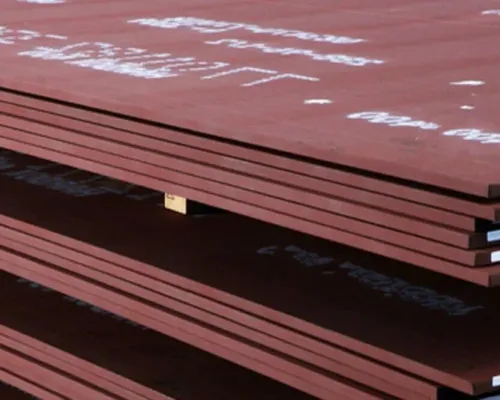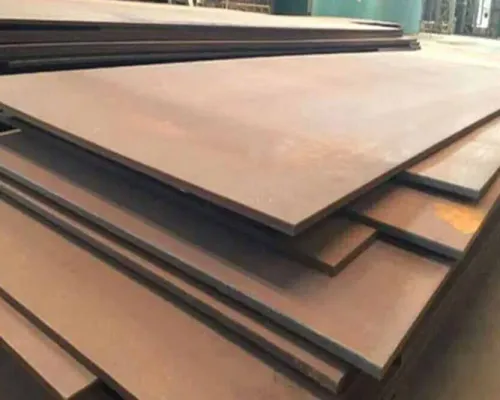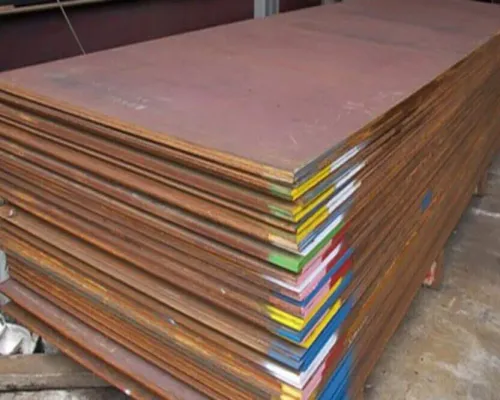


Choosing between S690QL and S890QL requires more than comparing a quoted strength value. You need to match the EN 10025-6 grade, thickness band, −40 °C impact requirement, certificate data and welding procedure to the actual load-bearing fabrication. By the end, you will know what to request from an Indian supplier and when a lower-strength grade is the safer engineering choice.
Key takeaways
- Check EN 10025-6 yield strength against the ordered plate thickness.
- Request the heat number, inspection certificate, and impact-test temperature.
- Select S690QL or S890QL based on weldability, design loads, and fabrication limits.
- Do not substitute structural grades for SA387 pressure-vessel plate.
S690QL and S890QL: what the grade designation actually means
EN 10025-6 defines S690QL and S890QL as quenched-and-tempered structural steel designations, not generic names for any 690 MPa or 890 MPa plate. For plate up to 50 mm, the nominal minimum yield strength is 690 MPa for S690QL and 890 MPa for S890QL; the specified minimum falls in thicker bands.
| Grade | Minimum yield strength up to 50 mm | Approximate tensile strength | Impact designation |
|---|---|---|---|
| S690QL | 690 MPa | 770–940 MPa | QL: −40 °C |
| S690QL1 | Separate class; confirm the thickness table | Confirm the certificate | Exact impact class required |
| S890QL | 890 MPa | 940–1,100 MPa | QL: −40 °C |
Tensile strength is the breaking-strength range, not the guaranteed yield strength. QL identifies impact toughness at −40 °C, so a quotation stating only “S690” or “S890” is incomplete for an EN 10025-6 order.
S690QL1 is a separate impact class within the standard. Order that exact designation; do not treat S690QL1 as an interchangeable label for S690QL or S890QL.
- Ask any alloy steel for plates supplier in India to state EN 10025-6, the QL or QL1 designation, quenched-and-tempered condition and the applicable thickness band.
- A search for an S690QL plate supplier in India can return “700-grade” material, but that marketing term does not prove equivalent yield strength, −40 °C toughness or certification.
- Choose S890QL only after design checks confirm the benefit: its higher strength can reduce plate thickness and dead weight, but it is not a universal replacement for S690QL.
What the EN 10025-6 certificate must prove for your thickness
The certificate must prove compliance for the plate you ordered, not merely display “S690QL” or “S890QL.” Check it in this order:
1. Confirm the ordered grade, EN 10025-6, quenched-and-tempered delivery condition, heat number, plate thickness, dimensions and applicable thickness band. The stated minimum yield strength must match that thickness; the value decreases in thicker bands.
2. Check the reported results for yield strength, tensile strength, elongation and chemical analysis. The certificate must identify the impact-test direction and show Charpy V-notch testing at −40 °C for the QL class. Reject “impact tested” without the absorbed-energy value specified for your exact grade and thickness.
3. Request an EN 10204 3.1 inspection certificate in the purchase order when you need heat-traceable chemical, tensile and impact results. EN 10204 2.2 gives non-specific test results and weaker traceability, so it cannot establish the same link between your plate and the reported tests.
4. Specify thickness tolerance under EN 10029 and surface condition under EN 10163 as separate requirements. If internal quality matters, state the EN 10160 class, scanning coverage and acceptance criteria; ultrasonic testing is not automatic with either grade.
A S690QL high tensile steel plate supplier in India and an S890QL plate supplier India should quote these details before dispatch. “Test certificate available” is not enough.
How chemistry, welding and cutting change the buying decision
A grade name does not prove weldability. Before buying, review the certificate for carbon, manganese, silicon, phosphorus, sulphur and each alloying-element limit, then calculate or confirm the stated carbon equivalent or hydrogen-cracking index for the ordered heat.
Use this fabrication review before approving the plate:
- Match thickness and joint restraint to the qualified WPS/PQR. Check its heat-input range, consumable hydrogen level, preheat temperature and maximum interpass temperature; those limits control the work, not a generic welding chart.
- Do not specify one universal preheat temperature. Excessive heat input or prolonged high interpass temperature can soften the heat-affected zone and reduce toughness in quenched-and-tempered plate, while insufficient preheat increases hydrogen cracking risk.
- State whether the plate will be flame-cut, laser-cut, drilled or cold-formed. These operations can create a hardened edge, residual stress or cracking, so define cutting parameters, edge inspection, machining allowance and post-cut preparation where required.
- Apply tighter control to S890QL than S690QL. S890QL can reduce thickness and dead weight, but its higher strength leaves less tolerance for hydrogen, restraint, weld defects and heat-affected-zone softening.
- Preserve the mill’s quenched-and-tempered condition. Uncontrolled reheating, forming or repair welding can change the properties certified for the plate.
An s690ql plate supplier in india should therefore quote fabrication limits with the material, not just “700-grade” marketing. Ask for the heat number and certificate so the chemistry and qualified procedure remain traceable from cutting through final welding.
Why S690QL and S890QL are not substitutes for SA387 pressure-vessel plate
S690QL and S890QL are load-bearing structural steels selected under EN 10025-6, not pressure-vessel materials. SA387, including ASTM/ASME A387 Grades F5 and F9, is specified for pressure-vessel plate and carries different chemistry, mechanical-property, heat-treatment and code-design requirements.
| Material family | Primary design use | Approval basis |
|---|---|---|
| S690QL or S890QL | Crane booms, bridge members and heavy structural fabrications | EN 10025-6 grade, thickness-dependent strength, toughness and structural design checks |
| SA387 F5 or F9 | Pressure vessels and pressure-retaining equipment | A387/SA387 requirements plus the governing vessel code, design temperature, stress limits and fabrication rules |
An “alloy steel plate” description does not make a plate acceptable for a pressure boundary. Equally, SA387 is not automatically suitable for a crane boom or bridge member: its pressure-vessel properties and code basis do not replace structural buckling, fatigue, connection and weld-detail checks.
A competent alloy steel for plates supplier in India should quote:
- Original rolling mill identity and heat number
- Exact grade, standard and thickness, with plate dimensions
- Quenched-and-tempered delivery condition
- Test direction and Charpy impact-test temperature
- EN 10204 3.1 inspection documentation
- Thickness tolerance, flatness and surface condition
- EN 10160 ultrasonic-testing class, coverage and acceptance criteria, when required
Shyam Metals & Alloys can be considered for sourcing these separate product families, but approve the plate against the design code and service duty, not a shared supplier catalogue.
Related products
 | Alloy Steel Plate Grades View product → |
 | Alloy Steel Plate Grades View product → |
Choosing the right grade for cranes, bridges and heavy fabrications
Choose S690QL when high yield strength helps the design but S890QL would make welding, fatigue control and fabrication access unnecessarily demanding. Consider S890QL only after the engineer proves that lower thickness or dead weight improves the complete structure.
| Grade | Design advantage | Checks before approval |
|---|---|---|
| S690QL | Strong structural plate with a wider fabrication margin | Welding procedure, fatigue life and access |
| S890QL | Potentially thinner, lighter members | Buckling, connections, bearing, fatigue and weld detail categories |
| S355 or IS 2062 | Greater stiffness and simpler fabrication | Weight, impact, availability and required strength |
For cranes, excavator booms and heavy frames, higher yield strength does not prevent slender-member buckling, stress concentration, weld fatigue or local wear. A thicker S355 or IS 2062 plate can therefore outperform a thinner high-strength plate when stiffness, impact resistance, availability or simpler welding controls decide the design.
For bridges, obtain the project’s fatigue and fracture-toughness criteria before approving a high-strength substitution. The engineer must confirm the complete member, connection and weld design, not just the plate’s yield value.
A search for “s890ql plate supplier india” or “s690ql high tensile steel plate supplier in india” can return cut pieces marketed as “700-grade.” Preserve the original heat number and mill certificate; without them, a service-centre piece loses credible chemical, mechanical and impact traceability.
Confirm these points before placing the order:
- Cut-piece traceability to the original mill heat and certificate
- EN 10025-6 designation, thickness tolerance and flatness
- Surface class under the specified EN 10163 requirement
- Required ultrasonic testing, including EN 10160 class and acceptance criteria
- Original mill plate rather than unsupported “700-grade” marketing
Frequently asked questions
What do S690QL and S890QL mean?
They are quenched-and-tempered structural steel grades under EN 10025-6, with nominal minimum yield strengths of 690 MPa and 890 MPa up to 50 mm thickness.
What must an EN 10025-6 certificate prove for the ordered plate?
It must identify the grade, plate thickness, heat or cast number, chemical analysis, tensile results, yield strength, elongation, impact-test results, and delivery condition.
How do chemistry, welding, and cutting affect the buying decision?
Carbon equivalent, plate thickness, preheating, heat input, hydrogen control, cutting method, and edge preparation determine fabrication risk and procedure requirements.
Can S690QL or S890QL replace SA387 pressure-vessel plate?
No. S690QL and S890QL are structural grades; SA387 is specified for pressure-vessel and elevated-temperature service, with different qualification and design requirements.
Which grade suits cranes, bridges, and heavy fabrications?
Choose the grade from the design code, required strength, thickness, toughness, weld procedure, fatigue demand, and fabrication capability rather than yield strength alone.
Related products
High Strength Plates View product → |
High Tensile Plates High Tensile Plates En10028 S690Ql View product → |