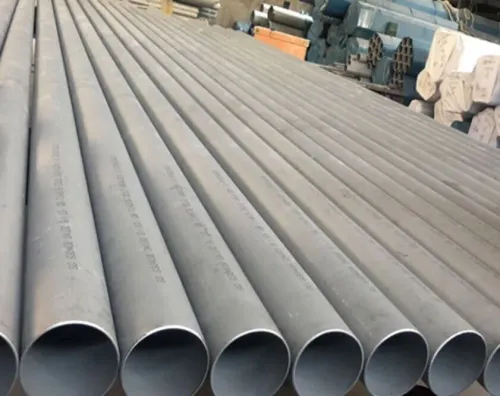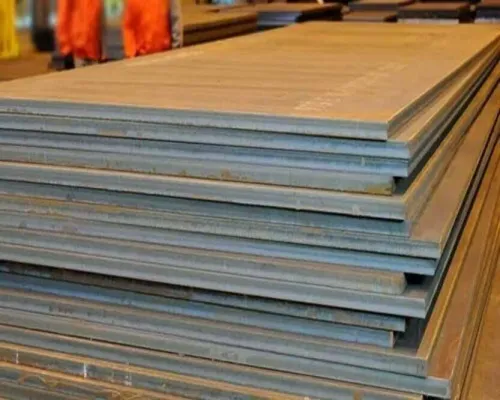


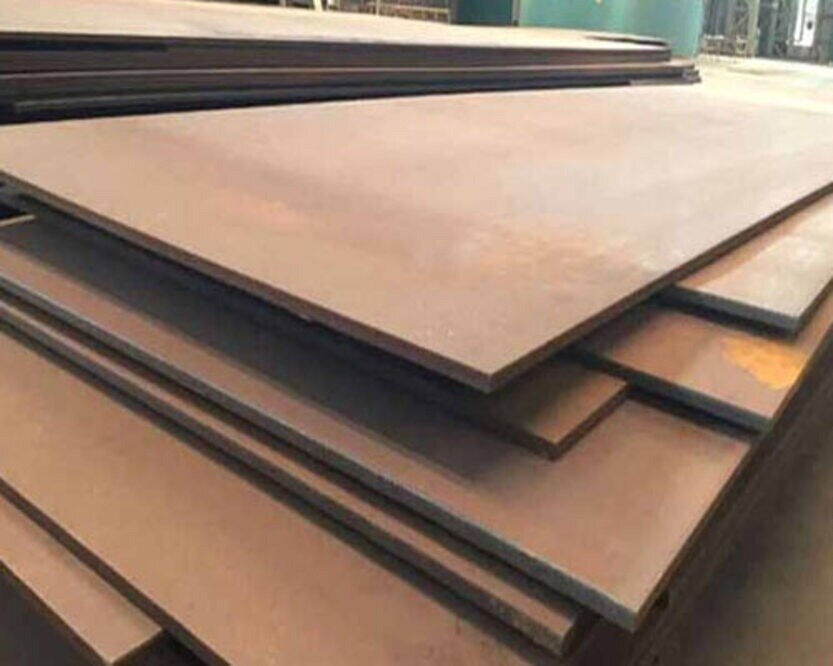
An Abrex 400 plate is not created by rolling ordinary steel to a specified thickness; its wear performance comes from controlled chemistry, clean steelmaking, hot rolling and a carefully managed hardening cycle. By following each production stage, you can distinguish original-mill plate from an equivalent AR400 product and ask for evidence that the delivered material has the required hardness, toughness and traceability.
Key takeaways
- Check the mill test certificate against chemistry, hardness and ordered dimensions.
- Confirm whether the application needs 400-HBW wear resistance or a different grade.
- Specify plate thickness, width, length, tolerances and cutting requirements before ordering.
- Use heat numbers to trace plates from the cast slab to delivered stock.
How the mill prepares steel and casts the slab
A cast slab begins with a measured charge of iron units, scrap and alloy additions. The mill melts it in a basic oxygen furnace or electric arc furnace, then transfers the steel to a ladle for chemistry and cleanliness control.
| Furnace route | Main charge | Production implication |
|---|---|---|
| BOF | Hot iron, scrap and alloy additions | Uses liquid iron from an integrated steelmaking route |
| EAF | Scrap, iron units and alloy additions | Melts a metallic charge using electric power |
Ladle refining adjusts carbon, manganese, chromium, nickel, molybdenum and boron. Vacuum treatment removes dissolved hydrogen and nitrogen, while flotation and filtration reduce non-metallic inclusions. Do not compare carbon-equivalent limits until the quotation identifies the original ABREX mill datasheet or product standard; ABREX is a proprietary brand, not a universal chemistry table.
The refined steel is continuously cast into a slab. Operators control mould level, casting speed, secondary cooling and strand cleanliness so the solidifying steel does not develop excessive segregation or surface cracking.
Inspect the slab for centreline segregation, cracks, laminations and inclusions before scarfing or conditioning. Trapped inclusions can become fatigue or delamination sites after rolling, while centreline segregation creates hardness and toughness differences through the thickness.
The heat number starts here and must follow the plate, packing list and certificate. A listing that calls itself an “abre x 400 plates manufacturer in india” still needs original-mill traceability.
How rolling, cooling and tempering create the 400-HBW class
A slab becomes abrasion-resistant plate through controlled reheating, rolling, cooling and heat treatment—not through hardness added after ordinary hot rolling.
- Reheat the slab into a controlled austenitising temperature range, remove scale by high-pressure water, and pass it through a reversing or controlled-rolling mill.
- Apply sufficient reduction to break down the cast structure, close internal discontinuities and improve thickness uniformity.
- After the final pass, use accelerated cooling or direct quenching to control transformation into a hard martensitic or martensite-dominant structure.
- For quenched-and-tempered plate, run a separate tempering cycle to reduce quench stresses and balance hardness with toughness.
| Condition | Production route | Practical result |
|---|---|---|
| N | Heat into the austenite range, then air cool | Lower hardness and easier forming than quenched-and-tempered wear plate |
| Q+T | Quench after rolling, then temper separately | Usual route for ABREX 400 and ABREX 500 wear plate |
The 400 in ABREX 400 describes a nominal Brinell-hardness class, not a 400 MPa yield-strength grade. Published ABREX data commonly place ABREX 400 around 370–430 HBW and ABREX 500 around 450–530 HBW. The governing certificate controls the acceptance range, test method and sampling location.
A listing that says abre x 500 plates manufacturer in india still needs verification: confirm the original mill, heat number and certificate, because a cut-to-size processor is not necessarily the plate manufacturer.
How Indian mills produce the ordered plate dimensions
After heat treatment, the mill either rolls the specified thickness and width from a slab or cuts those dimensions from a wider parent plate. It then cuts the required length with a guillotine, saw, oxy-fuel torch or plasma system.
| Route | What happens | What to confirm |
|---|---|---|
| Direct mill rolling | Thickness and width are produced during rolling; length is cut afterward. | Ex-mill dimensions, tolerances and minimum order quantity |
| Parent-plate processing | A wider plate is nested and cut into smaller or unusual sizes. | Cutting plan, yield, edge condition and dimensional tolerances |
| Stock processing | Existing inventory is cut, profiled or machined for dispatch. | Whether the listed size is actually available and mill-rolled |
A stock listing does not prove current availability or original-mill production. Ask whether the dimensions are ex-mill, cut-to-size or processed from stock, and request tolerances for thickness, width, length, flatness and squareness.
Thermal cutting is not metallurgically neutral. Oxy-fuel and plasma leave a heat-affected edge that can differ in hardness or crack sensitivity from the parent plate, affecting forming and machining.
For a formed or machined part, specify:
- Ground, inspected or as-cut edges
- Preheating or post-cut inspection requirements
- Marking retention and surface condition
- Quench uniformity, flatness and removal of scale, laps and rolled-in defects
An “abre x 400 plates stockist in india” listing still requires these checks before purchase.
Which documents and tests prove the plate is what was ordered
A genuine order needs a traceable mill record, not a report retyped by an abre x 400 plates supplier in India. Request an original-mill EN 10204 Type 3.1 certificate naming the mill, heat number, product designation, dimensions, delivery condition, chemical heat analysis and mechanical results.
Use this checklist before acceptance:
- Match the heat number stamped or painted on the plate with the packing list and certificate. A trader’s retyped report is not equivalent to a mill-issued Type 3.1 certificate.
- Check the hardness method, indenter, test location, test frequency, thickness range and permitted variation. Scale, surface preparation and plate curvature can shift a Brinell result.
- Request a hardness map across the plate for critical wear parts instead of accepting one reading.
- Add tensile and Charpy impact tests when the purchase specification requires them.
- Specify ultrasonic testing to detect internal laminations.
- Confirm that the delivery condition says Q+T, rather than only “400 grade.”
| Evidence | What it proves | What it does not prove |
|---|---|---|
| EN 10204 Type 3.1 certificate | Mill-certified chemistry and mechanical results for the heat | That every point on the plate has identical hardness |
| Hardness map | Distribution of hardness across a wear plate | Impact toughness or weldability |
| Tensile and Charpy results | Strength and low-temperature impact performance | Abrasion life by themselves |
| Ultrasonic test report | Internal discontinuities such as laminations | Surface hardness or chemistry |
Abrasion resistance, impact toughness, tensile strength and weldability are different properties. A harder plate can resist sliding wear yet crack under heavy impact, fail during forming or lose local wear resistance beside a weld.
How to select the manufacturing route for the real application
Choose the plate from the failure you need to prevent, not from the largest hardness number. A chute carrying sliding mineral rewards hardness; a dump body or hopper receiving impact needs toughness and resistance to cracking.
| Application evidence | Preferred route | Main risk |
|---|---|---|
| Sliding mineral abrasion | ABREX 400; consider ABREX 500 after checking design loads | ABREX 500 can resist more sliding wear, but its hardness increases forming force, machining difficulty and welding sensitivity. |
| Heavy impact loading | ABREX 400 or a tougher specified grade | Choosing ABREX 500 solely because “500” is higher can promote cracking under repeated impact. |
| Mixed wear and impact | Compare measured wear, impact severity, thickness and repair plan | The hardest plate is not automatically the longest-lasting component. |
Require a welding procedure based on actual chemistry, thickness, restraint, hydrogen control, preheat, interpass temperature and heat input. Keep low-hydrogen consumables dry; excessive heat input can soften the heat-affected zone and reduce nearby wear life.
Use the supplier’s cold-forming bend radius, not a mild-steel allowance. Carbide tooling and rigid fixturing improve machining, while thermal-cut edges may require grinding or inspection before forming or welding.
An ABREX 400 plates supplier in India may represent original-mill supply, importing, inventory holding or processing. An ABREX 400 plates stockist in India must be assessed separately for each responsibility. Shyam Metals & Alloys should be evaluated against the same evidence:
- Exact trademark and mill identity
- Heat traceability and certificate type
- Test reports and processing tolerances
- Responsibility for storage or transport damage
Related product
 | Resistant Plates Abrex (400 / 450 / 500 ) Item Abrasion Resistant Plate Material Abrex 400 /450 /500 /600 Thickness 6mm to 100mm Width 1,500mm to 2,500mm Length... View product → |
Frequently asked questions
How does an Indian mill prepare steel for Abrex 400 plates?
The mill charges iron units, scrap and alloy additions into a basic oxygen furnace or electric arc furnace, then transfers the melt to a ladle for chemistry and cleanliness control before casting.
How do rolling, cooling and tempering produce the 400-HBW class?
Controlled rolling reduces the cast slab to plate, while controlled cooling and tempering develop the hardness and wear-resistance range specified for the 400-HBW class. Confirm the result through the mill test certificate and hardness readings.
Which documents and tests should you request for Abrex 400 plates?
Request the mill test certificate showing the heat number, chemical analysis, plate dimensions, hardness results and applicable inspection standard. Match the heat number stamped or tagged on the plate to the certificate.
How should you choose between Abrex 400 and Abrex 500 plates?
Choose Abrex 400 when the design needs a balance of wear resistance, forming and fabrication. Consider Abrex 500 when higher hardness is essential, then check the effects on cutting, welding, forming and replacement work.