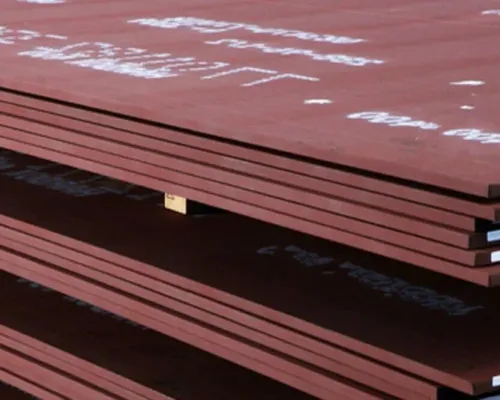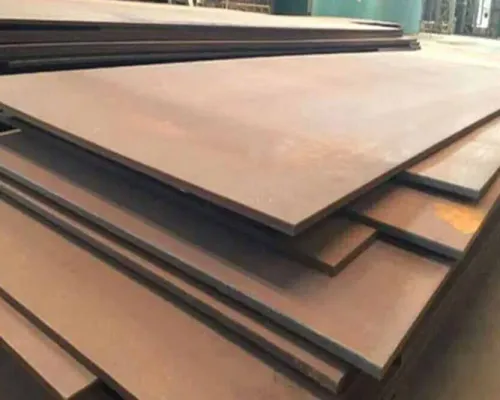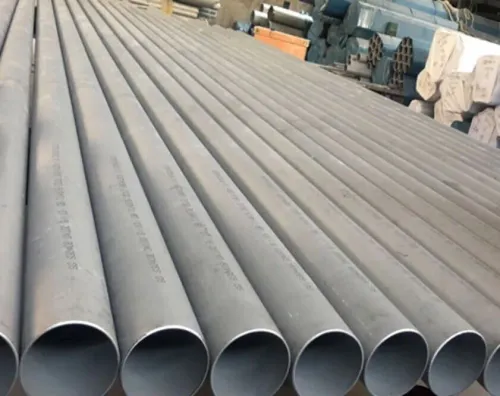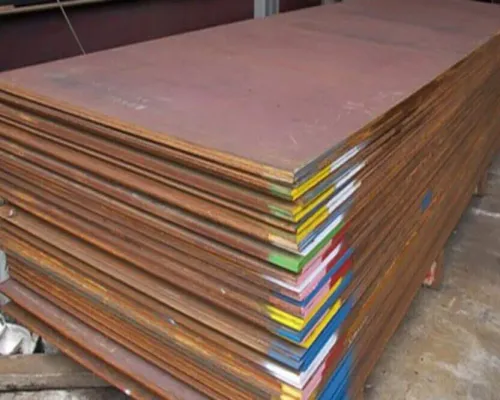


A failed machine plate does not prove that the original steel grade was too weak. You need to identify the failure mechanism, verify the ordered S690QL grade and thickness-dependent properties, then check welding, fabrication and traceability before selecting replacement plate.
Key takeaways
- Confirm EN 10025-6 compliance, thickness, heat number and Charpy impact results.
- Match replacement strength and toughness to the equipment’s actual failure mode.
- Use qualified welding procedures and control heat input before returning equipment to service.
- Compare suppliers on traceability, inspection documents, cutting accuracy and delivery capability.
What S690QL means and what its certificate must prove
690 MPa is not a complete grade description. Under EN 10025-6, S690QL means S for structural steel, 690 for the nominal minimum yield strength in MPa for plate up to 50 mm thick, Q for quenched-and-tempered delivery, and L for 27 J minimum Charpy V-notch energy at −40°C.
S690Q uses the same strength class but is impact-tested at −20°C; S690QL1 is tested at −60°C. A supplier must not relabel S690Q stock as S690QL. Whether you are comparing an S690QL high tensile steel plate supplier in India with an S690QL plate supplier in India, demand the exact subgrade.
Request an EN 10204 3.1 inspection document that proves:
- The applicable EN 10025-6 edition, heat number, plate dimensions and quenched-and-tempered delivery condition.
- Chemical analysis and thickness-dependent yield-strength and tensile-strength results, plus elongation.
- Charpy V-notch test temperature and individual results, confirming −40°C and at least 27 J.
Check every result against the ordered thickness: both yield and tensile-strength ranges reduce as thickness increases. A generic “690 MPa plate” claim can therefore conceal a nonconforming product.
EN 10160 ultrasonic testing is separate. For weld-critical orders, name the required class or acceptance level; do not assume S690QL guarantees internal quality.
S690QL composition, mechanical properties and grade comparisons
S690QL chemistry limits are maximum values; use the product-analysis figures on the EN 10204 3.1 certificate for acceptance.
| Element | C | Si | Mn | P | S | Cr | Mo | Ni | Cu | B | CEV | CET |
|---|---|---|---|---|---|---|---|---|---|---|---|---|
| Maximum | 0.20% | 0.80% | 1.70% | 0.025% | 0.015% | 0.50% | 0.70% | 2.00% | 0.30% | 0.005% | 0.65 | 0.47 |
EN 10025-6 strength falls with thickness, so “690 MPa plate” is incomplete.
| Thickness | Yield minimum | Tensile range | Elongation minimum | Charpy requirement |
|---|---|---|---|---|
| ≤50 mm | 690 MPa | 770–940 MPa | 14% | 27 J at −40°C |
| >50–100 mm | 650 MPa | 760–930 MPa | 14% | 27 J at −40°C |
| >100–150 mm | 630 MPa | 710–900 MPa | 14% | 27 J at −40°C |
| Grade | Impact temperature | Delivery/forming route | Strength and certification |
|---|---|---|---|
| S690QL | −40°C | Quenched and tempered; limited cold forming | EN 10025-6 |
| S690QL1 | −60°C | Quenched and tempered | EN 10025-6 |
| S700MC | −20°C, subgrade-dependent | Thermomechanically rolled | EN 10149-2 |
| S890QL | −40°C | Quenched and tempered | EN 10025-6 |
| S500MC | −20°C, subgrade-dependent | Thermomechanically rolled | EN 10149-2 |
| S355/S460 | Subgrade-dependent | Normalised, TMCP or quenched and tempered | EN 10025 series |
IS 2062 E650 and unspecified high-tensile plate are not automatic substitutes. Higher yield strength does not guarantee wear resistance, fatigue life, fracture toughness or weldability. Specify high tensile plates for industrial equipment by failure mode, not headline strength; an S690QL high tensile steel plate stockist in India must provide the exact grade and certificate.
Match the replacement grade to the actual equipment failure
Use S690QL for high tensile plates for industrial equipment when plate yielding limits load capacity and a verified redesign needs more strength or less component mass. It is not a universal repair grade.
Match the failure mechanism:
- Local denting indicates concentrated impact; check impact energy and use a tougher or thicker design where needed.
- Buckling indicates a slender, unsupported panel; assess span, supports, stiffeners and plate slenderness, not yield strength alone.
- Fatigue cracking at weld toes, holes or abrupt stiffness changes requires detail redesign. S690QL will not automatically extend fatigue life because weld category and stress range often govern.
- Brittle fracture requires investigation of temperature, defects, restraint, loading rate and stress concentration. Its Charpy rating does not eliminate crack risk.
- Sliding, gouging or impact wear points to Quard 400, Quard 450, Quard 500, Hardox or JFE Everhard; high yield strength is not an abrasion specification.
- Include corrosion thinning, hydrogen-assisted cracking and crack-like damage in the failure investigation.
Before requesting a s690ql plate supplier in india, record:
- Load, span, support condition and plate slenderness.
- Impact energy, fatigue cycles and service temperature.
- Corrosion allowance, weld details and visible damage mechanism.
Do not replace failed S690QL with thicker S355 solely to recover nominal capacity. The change alters geometry, buckling, weld restraint, impact performance and fatigue details; redesign the complete component instead.
Control welding, cutting and forming before the new plate enters service
A certificate proves parent-metal compliance; it does not prove that a fabricated assembly will retain fatigue or fracture performance. Qualify the welding procedure for joint restraint, thickness, heat input, consumable hydrogen level, preheat, interpass temperature and cooling control. Inadequate preheat or damp, poorly stored consumables can cause delayed hydrogen-assisted cold cracking.
Excessive heat input can reduce heat-affected-zone strength or toughness.
Do not assume PWHT is harmless. Tempering or prolonged exposure in an unsuitable range can alter S690QL’s quenched-and-tempered condition and reduce strength; validate it against producer data and the qualified procedure. Before release, require:
- Machined edges when thermal cutting leaves hardened or heat-affected material that the design cannot tolerate; inspect cut edges for cracks and unacceptable hardness.
- Controlled drilling, rather than uncontrolled flame-cut holes, where hole fatigue or dimensional accuracy matters.
- Forming limits that account for consumed ductility and residual stress; inspect bends for cracking.
- Inspection of weld toes, holes and repaired areas, especially on fatigue-critical details.
- Approval for flame straightening, because local heating can disturb the delivery condition.
| Process | Main risk | Release control |
|---|---|---|
| Thermal cutting | Hardened or heat-affected edge | Machine or inspect the edge |
| Cold forming | Ductility loss and residual stress | Follow qualified bend limits |
| Flame straightening | Tempering or condition change | Validate the heating method |
A S690QL plate stockist in India can provide traceable plate, but only the qualified fabrication record demonstrates assembly performance.
How to vet an S690QL supplier after an equipment failure
A failure investigation makes supply route less important than traceability: an S690QL high tensile steel plate supplier in India may source directly, while an S690QL high tensile steel plate stockist in India may hold imported prime plate, remnants or cut-to-size stock. Neither route proves better grade quality; compare the evidence.
| Supplier route | Stockist route | What to verify |
|---|---|---|
| Direct or mill-linked supply | Imported, stored or cut stock | Original mill certificate, heat identity and delivery condition |
| Prime plate allocation | Remnant or cut-to-size piece | Plate status, dimensions, storage history and corrosion loss |
| Planned replacement quantity | Available inventory | Same or compatible heat records for future replacements |
Require every quotation to state:
- EN 10025-6 S690QL, not “690 MPa” or “high tensile”
- Exact thickness, width, length and delivery condition
- Charpy test temperature and results
- EN 10204 3.1 inspection documentation
- Any specified EN 10160 ultrasonic-testing class
Match the heat number on the plate, certificate and cutting record. For imported heats, request the original mill certificate, not only a trader-issued transcription. Ask how heat-number transfer survives cutting and whether replacement quantities can carry the same or compatible heat records.
Shyam Metals & Alloys, a Mumbai-based S690QL plate supplier in India, should be assessed by this evidence just as an S690QL plate stockist in India should. Document review, grade verification and a failure-specific engineering assessment must precede selection; availability alone does not prove suitability.
Check the surface for pitting, lamination indications and measurable corrosion loss before accepting stock.
Related products
 | Alloy Steel Plate Grades View product → |
High Strength Plates View product → |
Frequently asked questions
What does S690QL mean under EN 10025-6?
S means structural steel, 690 indicates the nominal minimum yield strength in MPa for plate up to 50 mm thick, Q means quenched-and-tempered delivery, and L specifies 27 J minimum Charpy V-notch energy at −40°C.
What must an S690QL inspection certificate prove?
The certificate should identify EN 10025-6, S690QL grade, plate thickness, heat number, chemical analysis, tensile and yield results, elongation, Charpy impact results at −40°C, delivery condition and inspection standard.
How should you choose a replacement grade after equipment failure?
Identify whether the failure came from overload, fatigue, brittle fracture, wear, corrosion or a defective joint, then match strength, toughness, thickness, weldability and service conditions rather than choosing by yield strength alone.
What welding controls matter when replacing S690QL plate?
Use a qualified welding procedure, compatible low-hydrogen consumables, controlled preheat and interpass temperatures, suitable heat input, hydrogen control and inspection of the completed joint.
How do you vet an S690QL plate supplier in India?
Ask for traceable material certificates, heat-number marking, thickness and dimensional records, independent inspection options, controlled processing details and evidence that the supplied plate matches your repair specification.
Related product
High Tensile Plates High Tensile Plates En10028 S690Ql View product → |