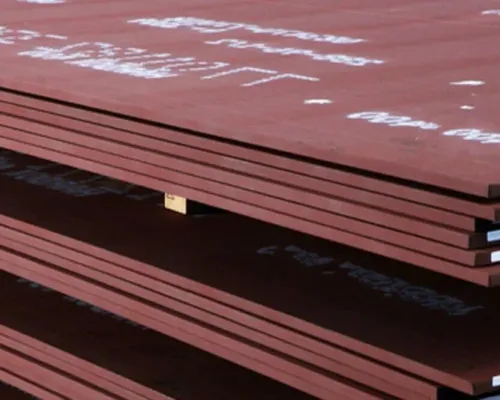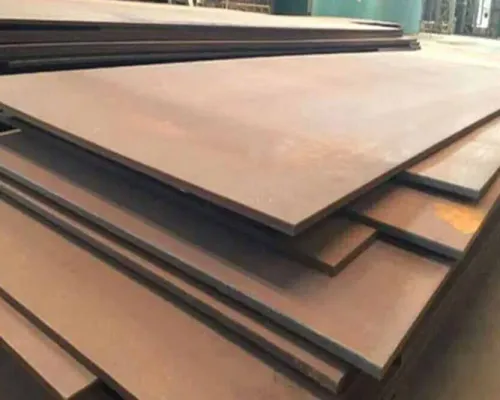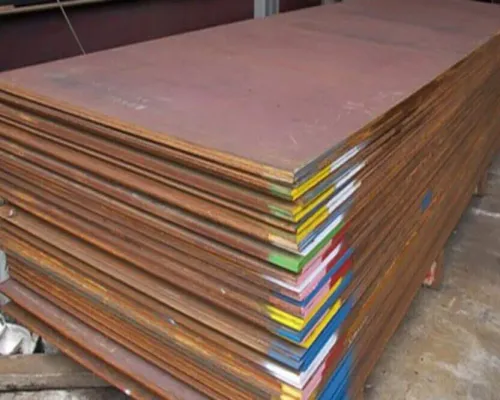


Fast supply depends on more than finding “S690QL” in a catalogue: the required thickness, impact class, heat traceability, certificate and cut size must already align. By checking the grade correctly, comparing fabrication trade-offs and sending a complete enquiry, you can identify a compliant stock route instead of buying an unverified 700 MPa substitute.
Key takeaways
- Check EN 10025-6, Q+T condition and thickness-specific yield strength.
- Match S690QL to lifting, mobile equipment and structural load requirements.
- Plan preheating, heat input and qualified welding procedures before fabrication.
- Verify the MTC, plate dimensions, delivery date and traceability before payment.
What S690QL means on a steel plate certificate
A genuine S690QL plate is an EN 10025-6 quenched-and-tempered structural steel, not any generic “700 MPa” material. Q+T means the plate was quenched and tempered to achieve its specified strength and toughness. The 690 denotes a nominal minimum yield strength of 690 MPa in the thinner thickness band; the specified minimum falls as thickness increases.
Check the mill certificate for these points:
- Confirm EN 10025-6, S690QL and Q+T delivery condition, rather than “700 grade” or an untested equivalent.
- Match the certificate’s thickness band to the specified yield strength; do not assume 690 MPa applies to every plate thickness.
- Check the tensile-strength range, elongation, chemical analysis and actual yield result.
- Confirm Charpy V-notch energy of 27 J at −40 °C, the test direction and individual results. The L designation identifies this low-temperature impact class.
- Do not treat S690QL1 as interchangeable: it is a separate designation associated with impact testing at −60 °C.
- Match the heat number, plate dimensions and marking to an EN 10204 3.1 or 3.2 inspection certificate.
A normalised plate does not automatically meet the Q+T requirement, and an “equivalent 700-grade” without specified testing is not S690QL. For s690ql plate availability india searches, verify the exact thickness, heat, impact class and certificate status; a product name alone proves nothing.
A 3.1 certificate is issued by the manufacturer, while 3.2 adds independent or purchaser-appointed inspection.
Where S690QL earns its higher strength—and where another grade fits better
Choose S690QL when a crane boom, lifting frame, transport chassis, mining machine, bridge member or heavy industrial support structure needs high yield strength without carrying unnecessary steel. A thinner section can reduce dead weight, but Young’s modulus remains about 210 GPa; it does not increase with yield strength.
Buckling, plate slenderness, fatigue or bolted and welded connection design can govern first, so do not replace S355J2, S500MC or S700MC by strength number alone.
| Grade | Main advantage | When another choice fits better |
|---|---|---|
| S690QL | Q+T structural strength for lighter load-bearing members | Use only after stability, fatigue and connection checks |
| S890QL | Higher yield strength than S690QL | Choose it only when its extra forming, welding and fabrication demands are justified |
| S700MC | High-strength thermomechanically rolled steel under EN 10149-2 | It follows a different product standard and delivery route, so it is not automatic S690QL equivalence |
| Hardox 400, 450 or 500 | Abrasion resistance | Use for sliding, impact and wear surfaces, not as an automatic structural-grade substitute |
For pressure-bearing equipment, specify the required EN 10028-6 pressure-vessel grade instead of structural S690QL. Choose abrasion-resistant plate for chutes, liners and buckets.
The added cost of qualified welding, controlled heat input, specialist forming and slower fabrication makes an s690ql plate for industrial fabrication poor value when a thicker S355J2 member meets strength, stability, fatigue and service-life requirements.
How welding, cutting and forming change the fabrication plan
Treat S690QL as a fabrication-controlled material, not as a welding procedure. Its grade designation does not define preheat, consumable, heat input or repair limits.
1. Qualify the welding procedure against the actual plate chemistry and thickness. Calculate carbon equivalent from the mill certificate, then set consumable strength and hydrogen classification, preheat, interpass temperature, heat input, joint restraint and cooling conditions. A nominal 690 MPa yield value is not enough.
2. Prevent hydrogen cracking before striking an arc. Use low-hydrogen consumables, keep electrodes dry under the specified storage conditions, remove oil, paint, moisture and rust from the joint, and control tack welds and restraint. Record any required post-weld holding or inspection.
3. Control repairs separately. Remove the defect without gouging into sound material, follow the qualified repair-welding procedure, and repeat the specified inspection; an extra pass does not restore properties lost through uncontrolled heating.
4. Use the approved thermal-cutting procedure before welding or machining. Flame or plasma cutting creates a heat-affected edge, distortion and possible hardening, so verify edge quality, remove unacceptable material and allow the specified cooling before further work.
5. Drill and machine with rigid workholding, suitable carbide or high-speed tooling, controlled feeds and cooling. Expect slower productivity than with conventional structural plate; dwelling at the tool can work-harden the surface and damage the cutter.
6. For cold bending, obtain the producer’s minimum bend radius and forming direction. Calculate accumulated strain, springback and residual stress, and apply any specified post-forming treatment. Never correct distortion with uncontrolled flame straightening: reheating or local heating can change properties and requires procedure qualification and certificate review.
How to secure fast S690QL plate supply in India
“Available” means an already-produced, traceable plate in the required size, not a catalogue listing. The fastest route is usually existing stock that matches your order; re-rolling, a new heat, special impact testing or a non-stock thickness can extend the schedule.
- Ask a mill for production and original certificates; confirm its manufacturing location and heat traceability.
- Ask a stockholder for a live list showing thickness, width, length, quantity, heat number, impact class, surface condition and certificate status.
- Use an importer when imported stock fits, but confirm arrival, customs clearance and original EN 10204 documents.
- Use a cut-to-length service centre when stock exists but dimensions differ; obtain the cutting lead time and post-cut heat-mark transfer plan.
- Treat a mill representative as a route to production, not proof of immediate stock. Confirm who issued the certificate and where the plate was made.
Send every enquiry with:
- EN 10025-6 grade and edition, Q+T condition, thickness, cut size and quantity.
- S690QL or S690QL1 impact class, edge and surface condition, and EN 10160 ultrasonic class where lamination control matters.
- EN 10204 3.1 or 3.2 certification, marking, packing and destination.
Evaluate an S690QL high tensile steel plate manufacturer in India or an S690QL high tensile plate manufacturer near Mumbai by certificate issuer and manufacturing location. Shyam Metals & Alloys is worth comparing on those records, not on listing language alone.
Related products
 | Alloy Steel Plate Grades View product → |
High Strength Plates View product → |
What to verify before accepting a Mumbai or India supplier’s quote
Before approving cutting, compare the offered heat and mill certificate against the purchase order. Reject a quote that says only “700 grade” or omits the Charpy impact temperature; “S690QL plate availability India” does not prove that the required size, heat, certification or impact class is ready.
Check the physical plate and documents against these acceptance points:
- Confirm plate marking, heat number, grade, thickness, dimensions and tolerances.
- Measure thickness and verify length, width, flatness and cut size against the order.
- Confirm surface condition, lamination-free evidence where specified, and cut-edge condition after processing.
- Match the heat number transferred to every cut piece with the original plate and certificate.
- Check Charpy results and test temperature, tensile strength, yield strength, elongation and chemical analysis.
- Request and review the ultrasonic report when the purchase order specifies internal-quality control.
| Comparison | Accept | Reject |
|---|---|---|
| Certificate identity | Exact S690QL heat, EN 10204 level and ordered impact class | “700 grade”, equivalent grade or missing impact temperature |
| Internal quality | EN 10160 class stated when lamination risk matters | Reliance on dimensional tolerance alone |
| Supply evidence | Traceable plate, certificate copy and cutting schedule | Verbal S690QL availability without stock proof |
EN 10025 dimensional tolerances control size; they do not guarantee internal soundness. Request EN 10160 separately. A high tensile steel plate supplier Mumbai search should also confirm dispatch date, cutting lead time, packing, transport destination and replacement terms in writing.
Choose the supplier that can show the exact traceable plate, certificate and processing schedule—not the one that merely promises S690QL availability.
Frequently asked questions
What does S690QL mean on a steel plate certificate?
S690QL identifies a quenched-and-tempered structural steel grade under EN 10025-6. The 690 refers to the nominal minimum yield strength in the thinnest thickness band, while the required minimum decreases as thickness increases.
Where is S690QL high-tensile plate used?
S690QL suits load-bearing fabrications that need high strength with lower plate weight, including heavy machinery, lifting equipment, transport structures and industrial construction.
What fabrication issues must you plan for with S690QL plate?
Control cutting heat, preheating, interpass temperature, heat input and welding consumables. Use a qualified welding procedure and confirm forming limits before bending or pressing.
How can you secure fast S690QL plate supply in India?
Send the grade, thickness, width, length, quantity, delivery location, certification requirements and cutting needs in one purchase enquiry. Ask the supplier to confirm available stock, mill origin and dispatch date.
What should you verify in an S690QL supplier quote?
Check EN 10025-6 grade designation, Q+T delivery condition, thickness-specific mechanical values, impact-test temperature, heat and plate numbers, MTC format, dimensions, tolerances, taxes, freight and delivery commitment.
Related products
High Tensile Plates High Tensile Plates En10028 S690Ql View product → |
 | Alloy Steel Plate Grades View product → |