

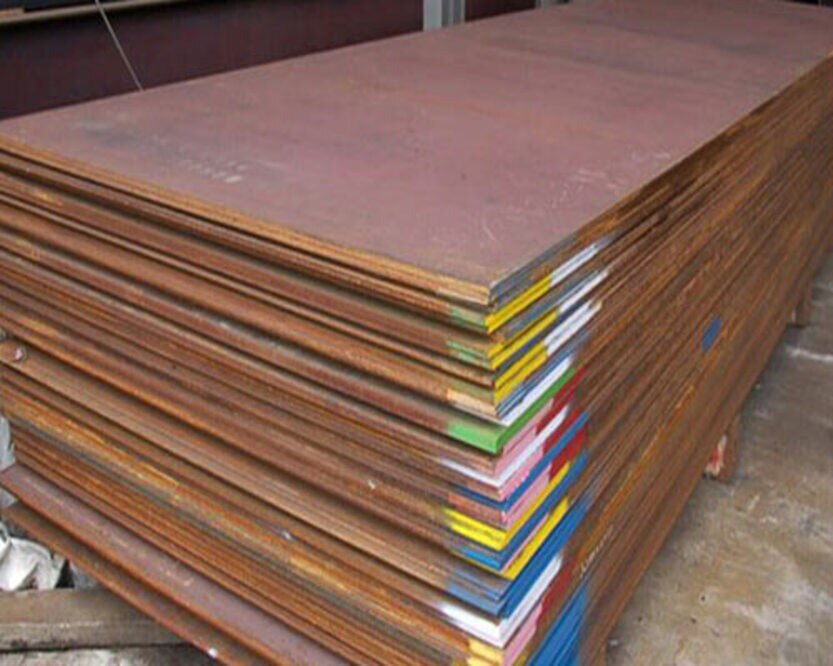
A “400” marking does not by itself tell you how a wear plate will perform, how deeply its hardness is guaranteed, or whether it can be welded and formed safely. You will be able to compare Rockhard grades, specify the evidence required on the mill test certificate, match thickness to the wear mechanism, and assess an Indian supplier’s quote by usable service cost.
Key takeaways
- Treat Rockhard 400 as a nominal 400 HBW hardness designation.
- Choose 450 or 500 only when added wear life justifies fabrication trade-offs.
- Verify hardness, thickness, heat number and test results on the mill certificate.
- Match plate grade to abrasion, impact, sliding or gouging wear.
What Rockhard 400 Means in Actual Wear Service
Rockhard 400 denotes an approximate nominal Brinell hardness near 400 HBW. It is a commercial designation, not a globally standardised steel grade or proof of chemical composition, tensile strength, impact rating or weldability class. Confirm those properties in the technical datasheet and mill test certificate.
Higher hardness usually improves resistance to sliding abrasion and gouging. It does not guarantee longer service when the duty includes high impact energy, fatigue or corrosive slurry. Service life also depends on abrasive particle shape and size, contact pressure, sliding speed, plate support and operating temperature. Two plates with similar hardness can therefore perform differently.
Ask a Rockhard 400 plates supplier in India:
- What permitted hardness range applies, rather than only “400 HBW”?
- Is hardness tested under ISO 6506-1 or EN ISO 6506-1?
- Where is each impression taken: near the surface, at a specified distance from the edge, or across the plate?
- How many plates, heats or test locations are sampled?
- Is the quoted value guaranteed across the full thickness?
A surface reading cannot prove uniform hardness through thick quenched-and-tempered plate. Cooling rate and distance from the quenched surface can create a hardness gradient. When an unplanned shutdown is costly, request an application-relevant abrasion test or site trial; choose on demonstrated wear performance, not the number 400 alone.
Rockhard 400, 450 and 500: When More Hardness Pays
Choose Rockhard 400 for general abrasive wear when impact, cutting, drilling and forming still matter. Move to 450 as abrasion increases but fabrication remains necessary. Reserve 500 for severe sliding or gouging wear after confirming that impact loads and fabrication demands are controlled.
| Designation | Practical choice | Main trade-off |
|---|---|---|
| Rockhard 400 | General abrasion with moderate impact and fabrication | More cutting, drilling and forming margin |
| Rockhard 450 | Higher abrasion with some fabrication required | Tighter forming and welding control |
| Rockhard 500 | Severe sliding or gouging wear with controlled impact | Reduced tool life, slower drilling and restricted forming |
The figures are commercial designations, not interchangeable standards. Before comparing Rockhard with Hardox 400, Quard 400 or JFE Everhard 400, request each manufacturer’s actual hardness range, test basis and technical datasheet. A hardness number alone cannot predict service life because particle shape, size, pressure, sliding speed, support and temperature change wear performance.
Harder plate reduces cutting-tool life and may require slower drilling. Cold bending demands the manufacturer’s minimum inside radius, bending direction, thickness and edge condition; a generic radius can crack the plate.
A rockhard 500 plates supplier in india should state the delivery condition and heat-treatment route. Excessive welding heat or prolonged elevated temperature can soften local regions of quenched-and-tempered plate. The designation alone cannot set preheat, interpass temperature, consumable, hydrogen-control limits or a qualified WPS; use the manufacturer’s welding guidance and the applicable qualified procedure.
How to Verify Hardness, Thickness and Mill-Certificate Evidence
Accept only the numerical hardness range written in the purchase order, not “400 HBW” alone. For example, use 360–440 HBW only when the manufacturer declares that range.
Require Brinell hardness in HBW under ISO 6506-1 or EN ISO 6506-1, with tests on the specified face, away from edges, at the stated frequency—such as every plate or each heat lot—and add a through-thickness test when uniform hardness is critical.
| Check | Evidence to require | Failure it prevents |
|---|---|---|
| Hardness | Individual HBW results, test location and sampling basis | Accepting a surface-only reading |
| Thickness | Measured dimensions and EN 10029 tolerance class | Treating nominal thickness as minimum thickness |
| Certificate | Original mill certificate tied to the heat number | Relying on an unverified reissue |
| Traceability | Plate marking matched through cutting and dispatch | Losing identity after fabrication |
A surface reading does not prove uniform performance through a thick quenched-and-tempered plate. Cooling rate, heat-treatment variation and distance from the quenched surface can create a hardness gradient. Do not convert HBW to tensile strength or another scale without the stated conversion standard and limits; ASTM E140 gives approximate conversions, not universal equivalence.
Check the certificate for heat number, chemical analysis, hardness results, dimensions, delivery condition and inspection standard. Confirm whether “in stock” means the exact thickness, width, length, heat and certificate are available. A Rockhard 400 plates stockist in India must prove those details, not merely quote a catalogue grade.
After cutting, retain the original heat number on each component and link it to the dispatch record.
Match Rockhard 400 to the Wear Mechanism and Component
Rockhard 400 fits components exposed to repeated abrasion with moderate impact, not every part that happens to wear.
- Crusher liners and screens: use it for repeated contact with crushed material when impact is moderate.
- Hoppers and chutes: use it where sliding bulk solids dominate and flow creates a predictable wear path.
- Dump bodies: use it when impact, gouging and payload weight must be balanced.
- Conveyor transfer points: use it where particle impact and controlled flow direction drive local wear.
- General wear liners: support the plate continuously or at close spacing to prevent deflection and fatigue.
Select thickness from the duty, not from “400” alone. Check abrasive type, particle size and shape, impact energy, material flow, support spacing, operating temperature, structural loads and the planned wear allowance. A thin hard plate can fail sooner than a thicker plate with better backing.
Choose another material or obtain additional design evidence when:
- Severe impact requires documented toughness, including the specified impact-test temperature and energy.
- Elevated temperature can reduce the plate’s hardness and wear resistance.
- Corrosive slurry makes stainless steel or another corrosion-resistant alloy more suitable. Stainless steel addresses corrosion; it does not automatically resist abrasion.
- A fatigue-sensitive frame needs structural design data rather than hardness alone.
- A pressure or load-bearing part requires IS 2062 or ASTM A36 properties, impact tests and certified weldability.
Compare Hardox, Quard, JFE Everhard, Rockhard 450 and Rockhard 500 through certified chemistry, hardness, toughness, strength and welding data. Names are not equivalent grades, and a higher number is not automatically better.
How to Compare a Rockhard Supplier’s Quote in India
Compare a Rockhard plates supplier in India by specification, traceability and usable-part cost—not by tonne price alone. Ask whether the offer is original hot-rolled, quenched-and-tempered plate or a cut component; the distinction affects residual stress, machining allowance, tolerances and weld procedure qualification.
Before accepting “in stock,” require:
- Exact thickness, width, length, flatness, tolerance basis and edge condition
- Heat-number traceability from plate marking through cutting and dispatch
- The original mill certificate, or a distributor reissue checked against original mill documentation
- A certificate heat number that matches the plate marking and states chemical analysis, hardness, dimensions, delivery condition and inspection standard
| Cost comparison | Add before deciding |
|---|---|
| Price per tonne | Base material price only |
| Cut-part cost | Cutting, edge preparation, machining allowance and scrap |
| Delivered cost | Freight, taxes, inspection, testing and minimum order quantity |
| Installed-part cost | Delivered cost divided by usable components |
A catalogue grade does not prove exact heat, size or certificate availability. Shyam Metals & Alloys is one supplier you can question on specification control, documentation, available cut sizes and application fit, then compare its answers with competing quotations.
Put these items in the purchase order:
- Hardness range and ISO 6506-1 or EN ISO 6506-1 test basis
- Delivery condition and welding guidance
- Dimensional tolerances, flatness and edge condition
- Heat-number and certificate traceability after cutting
Related products
 | Resistant Plates Rockhard(400 / 450 / 500 ) Thickness : 6mm to 100mm Width : 1,500mm to 2,500mm Length : 6,000mm to 12,000mm Production : Hot-Rolled (HR) /... View product → |
 | Abrasion resistant steel plate Plate is a type of high-strength, wear-resistant steel plate designed for demanding applications that require excellent durability and impact... View product → |
Frequently asked questions
What does Rockhard 400 mean in actual wear service?
Rockhard 400 describes an approximate nominal Brinell hardness near 400 HBW. It does not by itself prove chemical composition, tensile strength, impact performance or weldability.
When should you choose Rockhard 400, 450 or 500?
Choose Rockhard 400 for a balance of wear resistance, forming and welding. Select 450 or 500 when severe abrasion justifies harder plate and your fabrication process can handle the added difficulty.
How do you verify Rockhard 400 plate quality?
Check the datasheet and mill test certificate for the ordered thickness, hardness range, heat number, chemical analysis, tensile results and impact tests when specified. Match those details to the plate markings and delivery documents.
How do you match Rockhard 400 to a component?
Identify whether the component faces sliding abrasion, impact, gouging or a mixed mechanism, then consider the part’s thickness, shape, welding, bending and replacement access before selecting the plate.
How should you compare a Rockhard plates supplier in India?
Compare the exact hardness range, thickness tolerance, plate dimensions, certificate evidence, traceability, cutting capability, delivery terms and replacement policy rather than comparing only price per tonne.