

A wear-plate quotation is only useful when it identifies the actual mill source, hardness test, heat number, finished dimensions, fabrication requirements and delivery conditions. By the end, you will know what to submit with your enquiry, how to compare Rockhard grades and equivalent brands, and how to verify the plate before accepting it.
Key takeaways
- Confirm whether the seller manufactures, supplies or stocks the plate.
- Match the grade, thickness, dimensions and heat number to the test report.
- Set cutting, welding and forming procedures before fabrication begins.
- Compare traceability, delivery terms and inspection documents—not price alone.
What does “manufacturer,” “supplier” or “stockist” mean on a Rockhard enquiry?
A quotation label does not prove who made the plate. A rockhard plates manufacturer in India may produce the material; a supplier may procure domestic or imported plate; a stockist may hold selected sizes for immediate dispatch. Those routes differ in traceability, lead time, minimum quantity and available dimensions.
1. Ask the seller to identify the mill or manufacturing source, country of origin and authorised status. Confirm whether the plate is in current inventory or requires a mill order. Request exact thickness, width, length, quantity, available heat numbers and evidence of stock, such as heat-wise inventory or plate markings—not merely the word “available.”
- Target grade or hardness class
- Thickness, width, length and quantity
- Finished cut-piece dimensions and dimensional tolerances
- Application and wear mechanism
- Delivery location
- Surface condition
- Welding or bending requirements
- Required product standard
- Mill test certificate, hardness report, dimensional inspection report, ultrasonic report if applicable, heat traceability and certificate of conformity
3. Ask whether “Rockhard” is a trade designation or an equivalent grade, and require the comparison standard in writing. Clarify whether published dimensions describe stocked sizes, mill capabilities or enquiry-based supply ranges. Also ask whether the quotation covers full plates or cut pieces, and who bears cutting loss and minimum cutting charges.
A stockist may deliver faster; a mill-order route may offer stronger specification control but longer lead time.
What happens between the enquiry, cutting decision and dispatch?
A Rockhard order becomes dispatchable only after the supplier links the application, drawing, material heat and finished dimensions.
- Review the drawing and wear mechanism, including welding or bending.
- Confirm grade, nominal hardness and material standard.
- Check exact stock thickness, width, length, quantity and heat numbers.
- Approve full-plate or cut-piece dimensions, tolerances and edge condition.
- Nest the pieces and calculate kerf loss before cutting.
- Cut, then inspect dimensions, squareness, flatness and visible defects.
- Compile the mill certificate, hardness results, heat traceability and inspection reports.
- Pack, load and arrange transport against the approved delivery plan.
A full plate is sold as a mill-size item. A remnant is leftover stock with limited size and traceability; a cut piece is processed to your dimensions. Confirm minimum cutting charges, partial-sheet supply, finished-edge condition and who bears cutting loss. State whether quoted thickness means nominal plate thickness or cut-to-size thickness.
Cutting method changes the finishing work:
| Method | Main effect | Suitable use |
|---|---|---|
| Flame or oxy-fuel | Heat-affected edge and possible hardness change | Thick plate and large profiles |
| Plasma | Faster cuts, heat-affected edge and moderate tolerance | General cut pieces |
| Laser | Narrow kerf, low distortion and tight tolerance | Thin or detailed profiles |
| Waterjet | Minimal heat effect and no hardness change | Critical edges or heat-sensitive plate |
For a 6,000–12,000 mm plate, check route clearance, crane capacity, vehicle loading, turning radius and site access. Ask whether the quotation covers freight, taxes, unloading and site restrictions, and whether delivery is a full plate or finished pieces from a Rockhard plates supplier in India.
How do you distinguish Rockhard 400, 450 and 500 on paper and in the test report?
Treat Rockhard 400, Rockhard 450 and Rockhard 500 as nominal hardness classes unless the supplier’s datasheet defines them differently. The numbers commonly indicate approximate Brinell classes of 400, 450 and 500 HBW, not complete steel grades or chemical specifications. Rockhard 400 plates and Rockhard 500 plates therefore require more than a label comparison.
| Rockhard class | Impact level | Abrasive material and replacement interval | Fabrication limit |
|---|---|---|---|
| Rockhard 400 | Better tolerance of impact | Suited to mixed impact and sliding abrasion where toughness matters | Easier cutting, drilling, forming and welding |
| Rockhard 450 | Balanced impact and abrasion performance | Suited to moderate impact with abrasive feed; compare expected liner life | Moderate fabrication demands |
| Rockhard 500 | Lower impact margin than softer classes | Suited to severe sliding abrasion where longer replacement intervals justify constraints | Harder drilling, cutting, forming and welding |
A test report must identify the hardness method, indenter and load, test location, permitted range, heat number, and whether the result is a surface value, average or through-thickness requirement. Do not compare HBW directly with Rockwell or Vickers results.
Higher hardness can improve sliding-abrasion resistance, but it can reduce toughness, forming ability, machinability and fabrication tolerance. Request the named material standard, chemical analysis, mechanical results, heat-treatment record and mill certificate; specify EN 10204 3.1 or third-party inspection when required.
How should you select, cut, weld and form a wear plate for its actual service?
A Rockhard 500 label does not prove that the plate suits your liner. Start with the dominant failure mechanism, then record abrasive particle size and shape, impact energy, sliding speed, operating temperature, plate support and expected replacement interval.
1. Select against the service, not hardness alone. Rockhard 400, 450 or 500 can suit sliding abrasion, but severe impact or gouging may demand greater toughness. High temperature can alter performance; corrosion requires a corrosion-resistant solution; structural loading requires certified structural steel; pressure service requires the applicable pressure-vessel specification.
Tight bends may favour a softer grade.
2. Confirm the fabrication route before ordering. Use carbide tooling for drilling and machining, controlled cutting speeds, and the supplied grade-specific preheat guidance. State the minimum bend radius from the manufacturer’s data. Excessive hardness, a small radius or an uncontrolled heat-affected zone can initiate edge or bend cracking.
3. Obtain a welding procedure for the actual grade, thickness and heat number. Specify joint preparation, compatible low-hydrogen consumables, preheat, interpass temperature, heat input, restraint control and hydrogen protection; carbon equivalent, thickness, ambient temperature and restraint change the required controls. Do not apply an ordinary structural-steel procedure by assumption.
4. Treat primer or temporary protective paint as transport protection, not a corrosion system. Check its thickness and compatibility, remove it where welding occurs, and control moisture and hydrogen before striking an arc.
How do you compare quotations and accept the delivered plate?
Choose the offer that gives you traceability, not merely the shortest delivery date. A rockhard plates stockist in India may dispatch standard sizes quickly but offer fewer thicknesses, dimensions and heats; a mill-order route gives tighter specification control but brings longer lead time, minimum quantities and less flexibility for one-off cuts.
| Route | Advantage | Trade-off |
|---|---|---|
| Stockist | Faster dispatch from held inventory | Fewer sizes, heats and cut-piece options |
| Mill order | Stronger specification and document control | Longer lead time, minimum quantity and less flexibility |
Require each quotation to state:
- Grade designation, applicable standard, hardness test method, indenter and permitted range
- Heat number, chemical analysis, mechanical results and certificate type
- Thickness, width, length, dimensional tolerances, flatness and edge squareness
- Quantity, nesting plan, cut tolerance, bevels and drilled-hole dimensions
- Paint system, ultrasonic testing, inspection level and required inspection documents
- Freight, taxes, delivery date and replacement terms
At receipt, match the purchase order, packing list, plate stamping, heat number and mill test certificate. Measure dimensions and flatness, then inspect for laminations, surface defects, edge damage, rust and paint failure.
If markings are missing, heats are mixed, certificates conflict or dimensions exceed tolerance, quarantine the plates, photograph them and notify the seller. Request traceable replacement or an agreed inspection before use.
When evaluating Shyam Metals & Alloys, ask whether the plate is held stock, mill-procured or an equivalent grade, and whether each piece links to its heat.
Related product
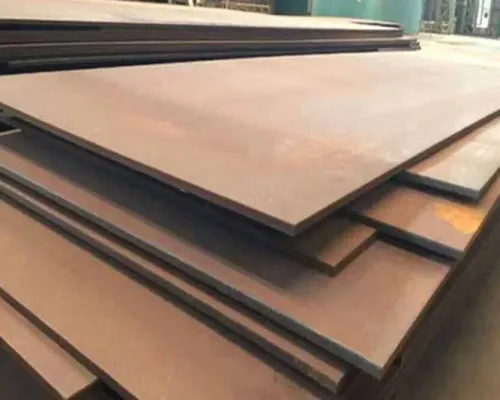
 | Resistant Plates Rockhard(400 / 450 / 500 ) Thickness : 6mm to 100mm Width : 1,500mm to 2,500mm Length : 6,000mm to 12,000mm Production : Hot-Rolled (HR) /... View product → |
Frequently asked questions
What do manufacturer, supplier and stockist mean on a Rockhard enquiry?
A manufacturer produces the plate, a supplier procures it from a producer or another source, and a stockist holds selected sizes for dispatch. Ask who made the plate, where it is held, and which documents trace it to the heat and test results.
What happens between a Rockhard enquiry, the cutting decision and dispatch?
The seller confirms grade, thickness, plate dimensions, quantity, tolerances, delivery location and documentation. The seller then checks available stock or production capacity, decides whether cutting is required, confirms the cut plan and packs the identified plates for dispatch.
How do you distinguish Rockhard 400, 450 and 500 on paper and in the test report?
Check the stated nominal hardness grade against the material test report, along with the hardness readings, chemical analysis, mechanical results, heat number, plate number and governing specification. Do not identify the grade from the quotation label alone.
How should you select, cut, weld and form Rockhard wear plate?
Select the grade for the impact, abrasion, load and temperature conditions in service. Use the supplier’s fabrication instructions for cutting heat input, preheating, welding consumables, interpass temperature and forming limits before processing the plate.
How do you compare Rockhard plate quotations and accept the delivery?
Compare grade, thickness, dimensions, quantity, hardness range, tolerances, origin, lead time, cutting charges, freight, inspection documents and warranty terms. On delivery, check markings, dimensions, surface condition, plate count, heat numbers and the test report.