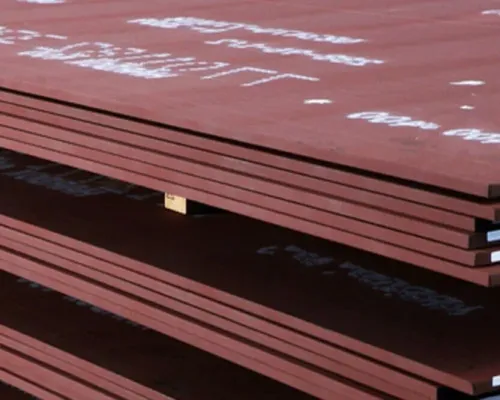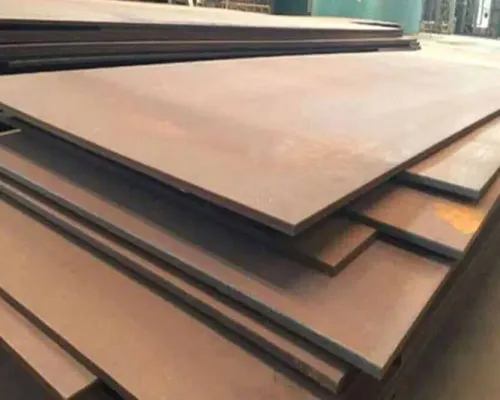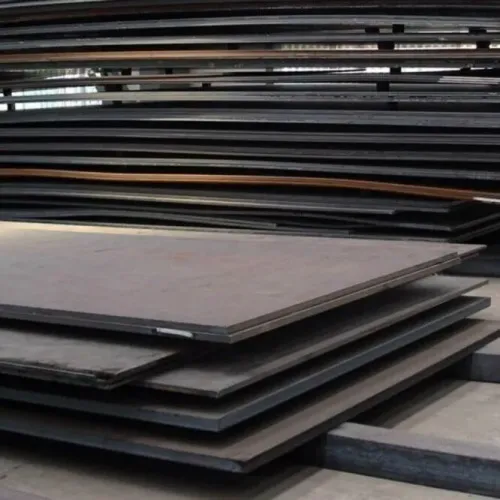
A wear plate fails when its hardness is treated as the whole design decision. You will be able to identify the wear mechanism, compare Rockhard grades, prepare a purchase specification, and avoid fabrication choices that shorten service life.
Key takeaways
- Treat 400, 450 and 500 as hardness classes, not complete steel specifications.
- Match Rockhard plate grade to abrasion, impact, temperature and loading conditions.
- Demand mill test certificates, heat numbers, dimensions and hardness results before purchase.
- Control preheating, welding consumables and inspection to avoid fabrication cracks.
Read the hardness number before choosing a grade
The numbers 400, 450 and 500 usually describe an approximate Brinell hardness class, not a complete steel specification. They indicate resistance to indentation and often correlate with sliding-abrasion resistance, but they do not prove impact toughness, weldability, chemistry or service life.
Treat each name as a commercial designation until the supplier identifies the underlying grade and standard.
| Grade | Approximate comparison range | What the number tells you |
|---|---|---|
| Rockhard 400 plates | 370–430 HBW | Lower hardness; usually easier to drill, machine, form and repair |
| Rockhard 450 | 425–475 HBW | Middle hardness; balances abrasion resistance with fabrication and toughness demands |
| Rockhard 500 plates | 470–530 HBW | Highest hardness; stronger resistance to cutting and sliding wear, with greater fabrication difficulty |
These ranges are comparison classes, not automatic acceptance limits for a Rockhard product. Require the manufacturer’s datasheet to state the HBW test method, test location, sampling frequency and whether the value is nominal or certified across an acceptance range.
A certificate showing only “400 BHN” does not establish chemistry, impact performance or weldability; the test designation itself also needs clarification because HBW uses a tungsten-carbide ball.
Do not choose Rockhard 500 plates solely because 500 exceeds 400. Harder plate can increase drilling time, forming force, preheat demands and cracking risk. Choose Rockhard 450 when you need more abrasion resistance than Rockhard 400 plates but still need practical cutting, welding, maintenance and impact tolerance.
IS 2062 is not an abrasion-grade substitute merely because it is easier to source.
Match the plate to the way your equipment wears
Sliding abrasion usually points to Rockhard 500; severe impact favours Rockhard 400; mixed sliding and impact often makes Rockhard 450 the practical starting point. Gouging wear needs toughness as well as hardness, so choosing the hardest plate by catalogue number can shorten service life if the plate chips or cracks.
| Wear mechanism | Starting grade | Why it fits |
|---|---|---|
| Sliding abrasion | Rockhard 500 | Resists mineral particles dragged across chutes, liners and conveyor transfer points; confirm that impact is not severe. |
| Impact abrasion | Rockhard 400 | Absorbs repeated blows from falling rock, scrap or aggregate with lower risk of brittle damage. |
| Gouging abrasion | Rockhard 400 or Rockhard 450 | Handles large, sharp particles and concentrated loading; use 450 when sliding wear is also substantial. |
| Combined sliding and impact | Rockhard 450 | Balances abrasion resistance with toughness where neither mechanism clearly dominates. |
| Material-on-material wear | Rockhard 450 or Rockhard 500 | Select from contact pressure, sliding speed and seizure risk, not hardness alone. |
Rockhard 500 is not automatically the longest-life choice. Its higher hardness can increase drilling, machining, forming and repair difficulty, while Rockhard 400 can fail sooner under sustained sliding abrasion. Rockhard 450 often suits equipment exposed to changing feed sizes, moderate impact and continuous sliding.
Treat these grades as commercial designations until the supplier identifies the steel specification, certified hardness range and test method. Do not substitute IS 2062 structural steel simply because it is easier to source; its designation does not establish abrasion performance.
Use operating conditions to choose between 400, 450 and 500
Rockhard 450 is the better lifecycle choice when abrasion is serious but the equipment also sees impact, field repairs, drilling, or welded attachments. Rockhard 500 plates can resist severe sliding abrasion longer, yet their higher hardness can increase cutting difficulty, cracking risk and repair time.
Rockhard 400 plates suit heavier impact or easier fabrication when wear loss is acceptable.
| Grade | Operating condition | Lifecycle trade-off |
|---|---|---|
| Rockhard 400 plates | Repeated impact, moderate abrasion, frequent repair or extensive fabrication | Better fabrication and impact tolerance; faster thickness loss in severe sliding abrasion |
| Rockhard 450 | Combined sliding abrasion and impact, with planned cutting, welding or replacement work | Balanced wear life, toughness and repairability; often avoids the fabrication penalty of 500 |
| Rockhard 500 plates | Severe mineral abrasion, sliding or material-on-material wear, limited impact | Maximum hardness advantage; higher machining, forming, welding and cracking demands |
Use the 450 class when a 500 plate’s extra hardness will not offset downtime from difficult fabrication or premature impact damage. Choose 400 when impact energy, bending or repair access controls the failure; choose 500 when abrasion dominates and fabrication is completed under controlled procedures.
As a comparison point, common classes are about 370–430 HBW for 400, 425–475 HBW for 450 and 470–530 HBW for 500. These are not acceptance limits. Confirm the named manufacturer’s hardness range, test method and test locations; “Rockhard 450” remains a commercial designation until its governing specification is identified.
Turn a supplier quote into a verifiable purchase
Do not approve a quote that identifies only “Rockhard 450” and a price. Require a traceable specification tying the delivered plate to its manufacturer, heat, test results and fabrication limits.
- State the exact grade designation: Rockhard 400, Rockhard 450 or Rockhard 500; nominal thickness; plate dimensions; quantity; and delivery condition.
- Require the manufacturer’s hardness acceptance range, test method and test location. Approximate comparison bands are 370–430 HBW, 425–475 HBW and 470–530 HBW for 400-, 450- and 500-class plate, but the named manufacturer’s datasheet controls.
- Put the applicable material standard, specification number and revision on the purchase order. Do not accept IS 2062 as an abrasion-resistant substitute; its structural designation does not establish wear performance.
- Require the heat number on each plate or bundle and an original mill test certificate matching that number. The certificate must show chemistry, hardness, tensile or yield data when specified, impact results when specified, and through-thickness testing when required. “400 BHN” alone proves very little.
- Obtain written welding data covering carbon equivalent, thickness, restraint, hydrogen control, consumable strength, heat input and preheat/interpass temperatures.
- Obtain the minimum inside-bend radius for the ordered thickness and rolling direction. Never insert a generic “four times thickness” rule.
Shyam Metals & Alloys should identify these documents and fabrication limits in its quotation rather than leave them for discussion after delivery. Reject an offer that cannot connect the certificate to the plates you will receive.
Related products
 | Resistant Plates Rockhard(400 / 450 / 500 ) Thickness : 6mm to 100mm Width : 1,500mm to 2,500mm Length : 6,000mm to 12,000mm Production : Hot-Rolled (HR) /... View product → |
 | Abrasion resistant steel plate Plate is a type of high-strength, wear-resistant steel plate designed for demanding applications that require excellent durability and impact... View product → |
Fabricate and inspect the plate without creating a new failure point
Cutting and drilling create heat and stress concentrations, so use the selected plate’s fabrication data rather than treating it like mild steel. Rockhard 450 and Rockhard 500 plates demand particular care because higher hardness usually reduces machinability and increases cracking risk.
- Cutting: Use the supplier’s approved plasma, oxy-fuel or laser procedure, then remove dross and inspect the heat-affected edge for cracks. Do not leave sharp inside corners; use the drawing’s specified radius.
- Welding: Obtain a qualified welding procedure based on carbon equivalent, thickness, restraint, hydrogen control, consumable strength, heat input and preheat/interpass temperature. Nominal hardness alone cannot set these values. Clean, dry consumables and controlled cooling matter more than simply increasing heat.
- Bending: Confirm the minimum inside radius for the thickness and grade before forming. Do not force a Rockhard 500 plate around a radius approved only for Rockhard 400; cracking can start on the tensile face.
- Drilling: Use the specified carbide tooling, rigid clamping, suitable cutting speed and coolant. Do not flame-cut bolt holes unless the procedure permits it; a hardened, rough hole can become a fatigue crack.
- Inspection: Check thickness, flatness, cut-edge condition, hole diameter, bend radius and fit-up against the drawing. Nominal thickness alone is inadequate; dimensional tolerances and flatness are separate requirements under standards such as EN 10029.
Inspect completed welds visually and use the specified non-destructive test, such as magnetic-particle or ultrasonic testing, where the drawing or welding procedure requires it. Record heat numbers and repair any crack before coating or installation.
Frequently asked questions
What do Rockhard 400, 450 and 500 numbers mean?
They usually indicate an approximate Brinell hardness class. The number does not prove toughness, chemistry, weldability or service life.
How do you choose between Rockhard 400, 450 and 500 plates?
Choose from the wear mechanism and operating conditions. Use abrasion, impact, temperature, loading and fabrication requirements to compare the grades rather than hardness alone.
What should you verify in a Rockhard plates supplier quote?
Ask for the exact grade, plate dimensions, heat number, mill test certificate, chemistry, hardness results, tolerances and delivery documentation.
How can fabrication create a failure point in wear plate?
Incorrect preheating, welding consumables, heat input, cutting practice or inspection can cause cracking or weaken the joint. Follow the grade-specific fabrication procedure and inspect welds.