Replacing a pressure-vessel plate is not a matter of matching the old thickness and ordering an alloy sheet. You need to reconcile the nameplate, construction code, material grade and class, service conditions, repair welding procedure and traceability documents before the plate is cut. By the end, you will have a specification-led buying checklist and a method for checking whether the delivered material is suitable for controlled maintenance work.
Key takeaways
- Use vessel records and code calculations before choosing a replacement plate.
- Specify SA387 grade, class and heat-treatment condition in the purchase order.
- Match material selection to temperature, hydrogen exposure and corrosion service.
- Require the MTR, heat number and piece-level traceability before acceptance.
Start with the vessel records, not the supplier catalogue
A replacement plate is acceptable only when it matches the vessel’s design basis, not because a catalogue calls it alloy steel. Start with the nameplate, original drawings, material test report, repair history and code calculations—not the supplier catalogue. “Plate” is code-controlled; “sheet” is not proof of compliance.
Pull these facts from the vessel file before requesting quotations:
- Identify SA-387/SA-387M, the exact grade and class, nominal thickness, plate dimensions, heat-treatment condition and governing ASME edition.
- Confirm the original design pressure, design temperature, minimum design-metal temperature and remaining corrosion allowance.
- Check whether impact testing applies under the equipment code, material curve or exemption rules; state the test temperature, specimen orientation and acceptance criteria when required.
- Purchase SA-387 with the applicable SA-20/SA-20M requirements for chemical analysis, mechanical tests, tolerances, retesting and marking.
- Require the mill test report, heat number and piece-level marking to remain traceable before cutting, blasting, repacking or fabrication.
Use a specification-led enquiry for “alloy sheet procurement india,” and do not accept “alloy steel sheet” as the material description. The supplier’s location does not replace grade, class, thickness, condition or inspection criteria. Before cutting, reconcile every delivered piece with its MTR and heat number; otherwise a correct plate can become unidentifiable during maintenance.
Specify SA387 by grade, class and heat-treatment condition
SA-387 is an ASME pressure-vessel specification for chromium-molybdenum alloy steel plate; it is not a complete purchase description. “SA” identifies the ASME adoption of the ASTM specification, while the grade identifies chemistry and the class identifies mechanical-strength requirements.
For Grade 5, both classes use approximately 5% chromium and 0.5% molybdenum chemistry. The difference is strength:
| Material | Minimum yield strength | Tensile-strength range | Purchasing meaning |
|---|---|---|---|
| Grade 5 Class 1 | 32 ksi (220 MPa) | 60–80 ksi (415–550 MPa) | Standard lower-strength class |
| Grade 5 Class 2 | 40 ksi (275 MPa) | 70–90 ksi (485–620 MPa) | Higher-strength class |
Class 2 is not automatically a better replacement. Select it only when the vessel design, thickness, welding procedure and repair engineer accept its higher strength and associated qualification requirements. The mill test report must show the ordered class and the actual tensile and yield results.
State SA-387/SA-387M, Grade 5, Class 1 or Class 2, nominal thickness, dimensions, governing ASME edition and required heat-treatment condition. Specify normalized-and-tempered or quenched-and-tempered delivery when required by the specification, grade or thickness; “SA387” alone does not reveal the plate’s heat history. A catalogue label such as “alloy sheet” cannot replace these details.
The search phrase asme sa387 alloy steel sheets india is a sourcing query, not a technical specification.
Match the alloy to temperature, hydrogen and corrosion service
Chromium-molybdenum plate is the right choice for welded pressure equipment exposed to elevated temperature, hydrogen attack risk or high-temperature hydrogen service. Specify ASME SA-387/SA-387M by grade, class, thickness, heat treatment and governing edition; do not order “alloy sheet.”
| Material | Strength in service | Choose another material when |
|---|---|---|
| SA-387 Grade 5 | Cr-Mo resistance for elevated-temperature pressure equipment and many hydrogen-service applications | The design temperature, hydrogen partial pressure or Nelson Curve assessment exceeds the grade’s limits |
| SA-387 Grade 9 | Higher chromium content for hotter service and stronger oxidation or hydrogen-resistance demands | Wet corrosion, chlorides or contamination requires a corrosion alloy rather than low-alloy steel |
| SA-516 Grade 70 or stainless steel | Carbon steel suits lower-temperature pressure service; stainless steel suits selected wet-corrosion environments | Carbon steel lacks temperature or hydrogen resistance, or stainless steel introduces welding, thermal-expansion or cost problems |
Hydrogen service is not decided by the word “moly.” Check temperature and hydrogen partial pressure against the equipment design basis and API RP 941 material guidance.
For wet chlorides, acids or caustic exposure, assess carbon-steel corrosion rate and cracking mechanisms before choosing Cr-Mo; stainless steel, nickel alloy or a cladding system may be the safer answer.
A search for asme alloy steel plate supplier india is only the starting point. Your welding engineer must confirm the qualified WPS/PQR, consumable, preheat, interpass temperature, hydrogen control, PWHT and hardness limits. Impact testing also depends on minimum design-metal temperature, thickness and code exemptions; define the test temperature and acceptance criteria in the order.
Turn the maintenance requirement into a purchase order
A purchase order that says “alloy steel plate” leaves the supplier free to offer the wrong grade, class or heat-treatment history. Write the acceptance requirements into the enquiry before asking an alloy steel for plates supplier in india to quote.
1. Identify the code material as ASME SA-387/SA-387M, state the exact grade and class, and cite the governing ASME edition. Add SA-20/SA-20M requirements for chemical analysis, mechanical tests, tolerances, retesting and marking.
2. State nominal thickness, plate length and width, required quantity, permitted thickness tolerance, and whether the plate will be used whole or cut into replacement sections. Do not let “sheet” replace “plate” in the order.
3. Specify the delivery condition: normalized and tempered, or quenched and tempered where the grade and thickness require it. Require the mill certificate to record the actual heat treatment, not merely the words “SA-387.”
4. List supplementary acceptance tests: Charpy V-notch impact testing with test temperature and absorbed-energy criteria, ultrasonic examination to the named acceptance level, and any weld-repair or surface-condition restrictions. Define who performs each test.
5. Require a heat-specific MTR showing chemical composition, tensile strength, yield strength, elongation, hardness, impact results and heat-treatment details. State whether inspection occurs at the mill, Indian stockist or fabricator before cutting.
6. Require heat number, plate identification, edge marking, packing, certificate format and piece-level traceability after cutting, blasting or repacking. Shyam Metals & Alloys is worth asking to confirm which markings survive processing and which inspection records accompany each piece.
Related products
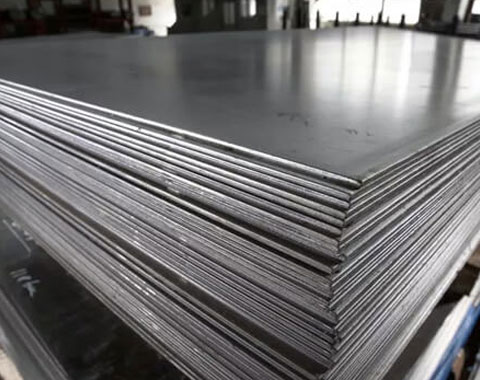 | Sheet and Plates Range : 3 mm to 100 mm thick in upto 2500 mm width upto 12500 mm length available with NACE MR 01-75s Carbon Steel : ASTM / ASME A 516 / 517 GR. View product → |
 | Alloy Steel Plate Grades View product → |
Verify the MTR, heat number and piece-level traceability
Do not release the plate for cutting until its physical markings, packing list and material test report (MTR) agree. The receiving inspection plan must state where verification occurs: mill, stockist or fabricator. Photograph each plate before blasting, cutting or repacking.
Check the MTR for these exact entries:
- SA-387/SA-387M designation, specification edition, grade and class
- Heat number and plate identification or serial number
- Ladle chemical analysis, including chromium and molybdenum
- Tensile strength, yield strength and elongation results
- Heat-treatment condition, nominal thickness and tested dimensions
- Required ultrasonic examination, impact tests and acceptance results
- ASME material designation or certification statement required by the construction-code edition governing the vessel
A certificate marked only “ASTM A387” does not prove acceptance for an ASME repair. Confirm that the certificate uses the ASME SA specification, or obtain the authorized engineering review required to accept an ASTM-listed equivalent under the vessel’s governing code edition.
Check impact test temperature, specimen orientation and acceptance values when the design code requires toughness testing.
Match every delivered piece to the MTR heat number before acceptance. If a plate has been cut, require the original heat number to be transferred by approved marking, stamping or a controlled tag onto every retained piece. Reject or quarantine material with a missing, altered or illegible identity until records prove the link.
A correct MTR cannot restore traceability after unidentified pieces have been mixed.
Frequently asked questions
What records should you review before buying a replacement alloy steel plate?
Review the vessel nameplate, original drawings, material test report, repair history and applicable code calculations before contacting a supplier.
How should you specify an ASME SA387 plate?
State the SA387 grade, class and required heat-treatment condition, then include dimensions, quantity, inspection requirements and traceability needs.
What service conditions affect alloy steel plate selection?
Check design temperature, hydrogen exposure and corrosion service because these conditions influence the suitable alloy grade and condition.
Which documents and markings should you verify at delivery?
Verify the material test report, heat number and piece-level markings, and confirm that each plate can be linked to its test results.
Related products
 | Alloy Steel Plate Grades View product → |
 | Alloy Steel Plate Grades View product → |