A quotation that says “ABREX 400” does not, by itself, prove that you are receiving original JFE Steel plate, the right hardness class, or usable stock dimensions. You will be able to check identity, certificate traceability, wear conditions, fabrication risks and landed cost before approving the purchase.
Key takeaways
- Ask for JFE Steel identification, heat number and delivery condition.
- Check the certified hardness range, not only the “400 HBW” label.
- Match plate hardness to impact, sliding or gouging wear conditions.
- Compare testing, fabrication, freight and documentation costs in each quote.
Prove that the plate is genuine ABREX 400
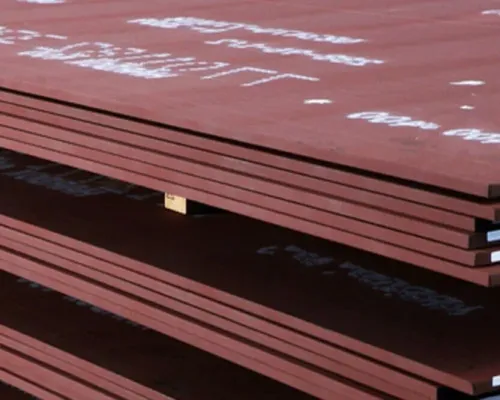
A genuine ABREX 400 plate must identify JFE Steel as the producer, not merely claim “400-HBW abrasion-resistant steel.” Ask for the exact ABREX grade, country of melt, heat number and delivery condition before placing the order.
Require an EN 10204 type 3.1 inspection certificate showing:
- JFE Steel as producer and the exact ABREX grade
- Heat number, country of melt and delivery condition
- Chemical analysis and supplied dimensions
- Grade-specific Brinell hardness or mechanical-test results
Use EN 10204 type 3.2 certification when your purchase specification or project quality plan requires independent inspection or witnessed testing.
| Document or marking | What to verify | What a mismatch means |
|---|---|---|
| Plate marking | Grade and heat number stamped or stencilled on the original plate | The material cannot be traced confidently |
| Bundle tag | Same heat number as the plate and certificate | The bundle may contain substituted material |
| Packing list and invoice | Same heat number and described grade | Commercial paperwork does not support the certificate |
| Imported-material file | Commercial invoice, packing list, bill of entry and country-of-origin statement agree | The claimed import route remains unproven |
Inspect photographs of the original markings before cutting. A seller-generated identification number is not enough.
If a seller calls itself an ABREX 400 plates supplier in India, ask whether it is JFE Steel, an importer, processor or stockist. Cutting JFE plate to size does not make the Indian company the steel manufacturer.
Read the hardness correctly and compare ABREX 400 with ABREX 500
“400” is a nominal Brinell hardness class, not a tensile-strength value or a guaranteed service life. ABREX 400 is usually about 370–430 HBW; ABREX 500 is about 470–530 HBW. Check every recorded reading, test location and permitted variation against the applicable JFE Steel product specification.
| Grade | Better choice | Limitation |
|---|---|---|
| ABREX 400 | More impact-toughness and fabrication margin | May wear faster in sustained sliding abrasion |
| ABREX 500 | Longer life in some sliding-abrasion duties | Higher hardness does not guarantee better severe-impact performance |
| ABREX 400 | Easier welding and cold forming | Requires suitable wear thickness and support |
| ABREX 500 | Better resistance to some sliding and fine-particle wear | Narrower welding and bending margins |
| Either grade | Replacement interval based on actual wear mechanism | Hardness alone cannot predict slurry or gouging life |
Choose ABREX 500 only when sliding wear dominates and its welding, bending and impact limits fit the design. A quotation from an abrex 500 plates stockist in india must include a genuine ABREX 500 mill certificate and matching plate marking.
“Equivalent to Hardox 400” does not prove interchangeability. Compare chemistry, hardness range, thickness limits, tolerances, heat treatment, delivery condition and fabrication instructions before substituting one plate for another. A harder grade that cracks during forming or welding can cost more than the wear it prevents.
Match the grade to the wear mechanism and operating conditions
ABREX 400 suits the equipment only after you identify how wear occurs, not because the plate carries a 400 HBW label. Record:
- Abrasive material, including mineral type, hardness and moisture
- Particle size and whether contact is sliding, gouging or impact
- Operating temperature and any corrosive chemical exposure
- Impact energy, load cycles, support spacing and replacement interval
- Required plate thickness, wear allowance, deflection limit and fabrication method
| Mechanism | Typical condition | Buying implication |
|---|---|---|
| Sliding abrasion | Fine mineral particles moving across a supported surface | Request slurry or sliding-wear evidence; hardness alone cannot predict life |
| Gouging wear | Large, sharp rock cutting or ploughing the plate | Compare toughness and gouging data, not only nominal hardness |
| Impact wear | Repeated drops, strikes or concentrated loads | Toughness can matter more than maximum hardness; record impact energy and cycle count |
Check whether the plate is continuously supported. A plate spanning gaps develops higher bending and fatigue stresses, so a thin nominal size can fail before its wear allowance is consumed.
Treat ABREX 400 as the wrong choice when elevated temperature, corrosion, fatigue cracking or pressure-vessel, bridge, crane or other structural-code certification controls the design. A wear plate does not automatically meet those codes. Ask for service references or wear-test results matching the actual mechanism, temperature and moisture conditions.
Confirm heat treatment, welding, bending and inspection requirements
Fix the plate’s heat-treatment condition, fabrication route and acceptance tests before it enters the workshop. ABREX 400 is not mild steel; a hardness value alone cannot define safe welding, bending or cutting.
1. Require the certificate to state N or Q+T. Normalised condition N and quenched-and-tempered condition Q+T produce different microstructures, hardness, toughness and fabrication responses. Treat neither label as interchangeable. Obtain the current producer’s instructions for the ordered thickness and delivery condition.
2. Make the welding procedure specification state preheat and interpass temperature limits, heat input, consumable classification, hydrogen-drying and storage controls, joint restraint, joint detail and the carbon-equivalent basis used for procedure selection. A procedure suitable for thin plate can fail on thicker or highly restrained plate through cracking or heat-affected-zone property changes.
3. Request cold-bending limits and minimum inside bend radius for the exact thickness and rolling direction. Do not apply mild-steel bend allowances: higher hardness reduces forming margin, and longitudinal and transverse bending limits can differ.
4. Write inspection into the order. Specify EN 10029 for thickness, flatness, width, length and edge condition, then define straightness, cutting loss, usable-area thickness and thermal-cut edge quality. If laminations matter, name EN 10160 or an agreed ASTM requirement and state full-area or sampling ultrasonic testing, acceptance class and reporting format.
“Cut to size” does not guarantee mill tolerances after processing.
Compare the complete Indian supplier quotation, not just the grade name
Compare the total delivered quotation line by line, not the word ABREX 400. Ask every seller to price the same grade, thickness, dimensions, quantity, delivery condition, certificate type and inspection scope.
Request these quotation lines:
- Cutting, packing, freight, GST, port charges and delivery to your location
- Usable dimensions, thickness at the remaining area, surface condition and straightness
- Full original plate, remnant, welded piece or laminated piece
- Photographs showing original plate markings before cutting
- Mill name, heat number, country of melt and traceability documents
| Seller type | Evidence to compare | Main risk |
|---|---|---|
| Manufacturer | Original mill certificate and matching plate marking | A claimed ABREX 400 plates manufacturer in India may only process imported JFE plate |
| Importer | Certificate, commercial invoice, packing list, bill of entry and country-of-origin statement | Locally relabelled or substituted material |
| Processor | Cut-size dimensions, replacement tag and preserved heat number | Cutting can hide markings and reduce usable area |
| Stockist | Original markings, heat number, condition photographs and inspection records | A remnant may not meet nominal 12 mm or 20 mm thickness |
For an abrex 400 plates stockist in india, require the heat number to survive cutting and appear on the replacement tag and documents. Assess Shyam Metals & Alloys using the same evidence: mill certificate, markings, dimensions, condition and fabrication guidance.
Treat an abrex 500 plates stockist in india as a separate claim; demand a genuine ABREX 500 certificate and matching marking, not a generic product list.
Related product
 | Resistant Plates Abrex (400 / 450 / 500 ) Item Abrasion Resistant Plate Material Abrex 400 /450 /500 /600 Thickness 6mm to 100mm Width 1,500mm to 2,500mm Length... View product → |
Frequently asked questions
How can you prove that a plate is genuine ABREX 400?
Request documentation identifying JFE Steel as the producer, the exact ABREX grade, country of melt, heat number and delivery condition. Match those details to the plate markings and mill test certificate.
How should you compare ABREX 400 and ABREX 500?
Compare the certified Brinell hardness range, toughness, forming limits, weldability and expected wear mechanism. ABREX 500 offers higher hardness, while ABREX 400 can provide easier fabrication where extreme abrasion resistance is unnecessary.
How do operating conditions determine the right abrasion-resistant grade?
Assess whether the part faces sliding abrasion, impact, gouging, corrosive slurry, temperature exposure or a combination. Use the grade that fits the dominant wear mechanism rather than choosing by hardness alone.
What fabrication and inspection details should you confirm before ordering?
Confirm heat-treatment condition, welding procedure requirements, preheating and interpass controls, minimum bending radius, plate thickness tolerances and inspection documents. Specify ultrasonic testing or other tests when the design or purchase specification requires them.
How should you compare quotations from an Indian ABREX 400 supplier?
Compare the exact grade and thickness, origin, heat number traceability, test certificates, inspection scope, cutting and forming services, packaging, freight, taxes, lead time and replacement terms—not just the price per kilogram.