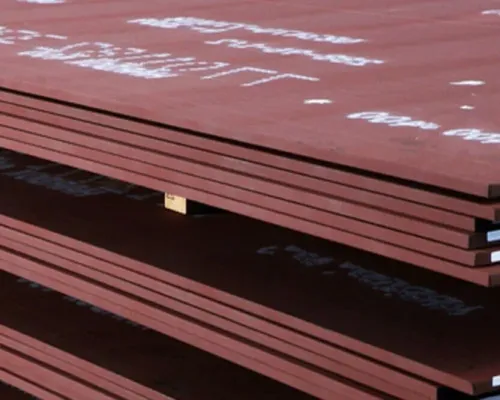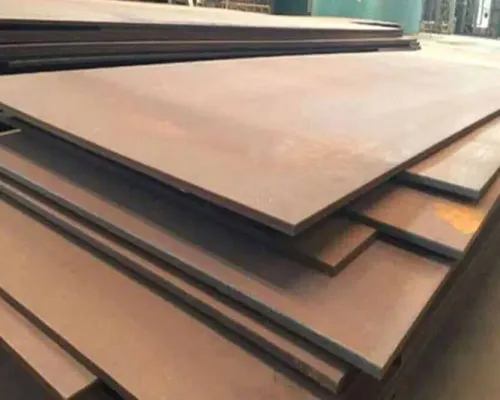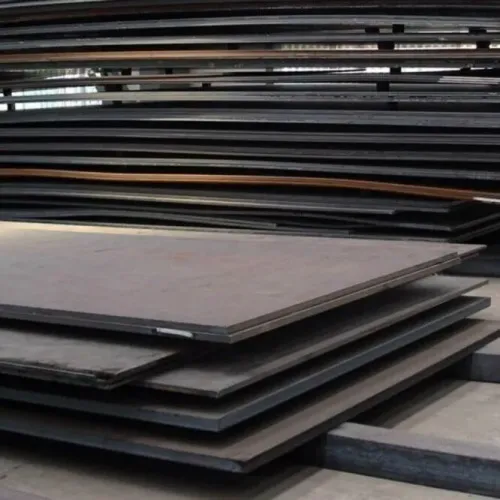
A failed liner, chute or truck body is not automatically asking for a harder plate. You will learn how to identify the wear mechanism, specify a traceable Rockstar plate and decide whether Rockstar 400, 450 or 500 fits the service without trading abrasion resistance for cracking or fabrication failure.
Key takeaways
- Classify impact, abrasion, corrosion and heat before selecting plate grade.
- Specify hardness range, thickness, dimensions, welding limits and inspection documents.
- Choose 400, 450 or 500 after checking forming, cutting and welding requirements.
- Ask Indian suppliers for mill certificates, heat numbers and traceable delivery records.
Diagnose the wear mechanism before changing the plate
A failed liner, chute, hopper, bucket, conveyor part or truck body must be classified by wear mechanism before you choose a replacement plate. Inspect the failure surface and record the operating conditions.
1. Polished, directional scoring indicates sliding abrasion from material moving across the plate. Deep furrows with displaced metal indicate gouging abrasion from coarse, sharp particles or trapped rocks.
2. Repeated dents, spalling or edge breakout indicate impact abrasion. Thinning beneath fast-moving wet fines points toward erosion; rust scale, pitting and thinning together indicate abrasion combined with corrosion.
3. Record the mineral type, particle size, moisture, load, impact angle, temperature, duty cycle and location of the deepest wear. Photograph the surface before grinding or cutting it.
4. Separate plate wear from other failures. Cracks beside a weld may originate in the weld or heat-affected zone; elongated bolt holes indicate fastening movement, while bowed panels indicate inadequate support, overheating or distortion.
A harder Rockstar 500 plate is not automatically the answer. Hardness can reduce cutting wear in sliding service, but it cannot correct poor backing support, severe impact or a restrained weld. A Rockstar 500 plates manufacturer in India should receive this failure record before recommending a grade.
Give the engineer the worn-part drawing, thickness, photos, repair history and service conditions, then compare Rockstar 400 against harder options on the actual failure mechanism rather than the hardness number alone.
Turn the replacement into a complete material specification
A quotation is incomplete if it names Rockstar 400 but omits the grade’s thickness coverage, test method and heat number. Rockstar 400 and Rockstar 500 are branded designations, not universal grades defined by one international standard.
Whether the quotation comes from a rockstar 400 plates supplier in india or another source, demand the manufacturer’s product datasheet and a heat-specific mill certificate.
Ask for these items in writing:
- Exact nominal thickness range for the quoted grade, plus width, length, dimensional tolerances and flatness limits.
- Surface condition, heat-treatment condition, cutting tolerance and ultrasonic-testing requirement or class.
- Heat number, plate number, chemical analysis and hardness results linked to the supplied plate.
- Carbon, manganese, chromium, nickel, molybdenum, boron and every other listed element’s heat-specific limits.
- Agreed Charpy test temperature, absorbed energy, specimen orientation and sampling frequency when impact or low-temperature service requires them.
| Grade | Common hardness expectation | What to require |
|---|---|---|
| Rockstar 400 | About 360–440 HBW | Confirm range for the supplied thickness and heat |
| Rockstar 450 | Manufacturer-stated range | Do not infer it from Rockstar 400 or 500 |
| Rockstar 500 | About 470–530 HBW | Confirm range for the supplied thickness and heat |
The certificate must report HBW, not an unexplained BHN value, and identify ISO 6506-1 when used. It must state whether testing occurred on the surface, after scale removal, at a defined distance below the surface or through the thickness. Thickness is a hidden variable: it affects hardness uniformity, chemistry, flatness, impact-test availability and certification.
A phrase such as rockstar 500 plates manufacturer in india proves none of those values.
Choose 400, 450 or 500 without creating a fabrication problem
Rockstar 400 is the safer choice when useful wear resistance must coexist with impact, frequent welding, drilling, cold forming or repair access. Choose Rockstar 450 or 500 only when service evidence shows that greater sliding-wear resistance justifies harder fabrication; the manufacturer’s datasheet and failure record decide the grade.
| Grade | Best fit | Fabrication consequence |
|---|---|---|
| Rockstar 400 | Mixed abrasion, shock loading, welded repairs and formed parts | More workable for drilling, bending and repeated repair |
| Rockstar 450 | Higher sliding abrasion with manageable impact and fabrication access | Needs tighter control of forming, cutting and welding |
| Rockstar 500 | Severe sliding or gouging wear where replacement frequency dominates | Greater cracking, edge-damage and machining risk |
Do not infer tensile strength, yield strength or impact toughness from HBW. A phrase such as rockstar 500 plates manufacturer in india is not evidence that every 500-HBW plate is interchangeable.
Before fabrication, obtain the supplied heat chemistry and calculate the specified carbon-equivalent formula. Use low-hydrogen consumables, controlled preheat and interpass temperatures, and the plate-maker’s welding procedure; high restraint or a hardened thermal-cut edge can turn a sound weld into a crack.
Use larger inside bend radii than mild steel, rigid drilling setups and wear-resistant tooling. Inspect cut edges for hardened or softened zones and apply the maker’s edge-preparation or cooling instruction.
For low-temperature or high-restraint service, write the Charpy requirement into the order:
- Test temperature
- Minimum absorbed energy
- Specimen orientation
- Sampling frequency
Do not assume impact performance from the grade name.
Compare competing wear plates by documents, not by numbers
Hardox 400/450/500, JFE Everhard 400/450/500, Quard 400/450/500, Rockhard 400/450/500 and Abrex 400/450/500 are not direct substitutes for Rockstar plate because a name and nominal hardness class do not prove equivalence. Compare the documents for the exact plate offered.
| Document to compare | Catalogue statement | Supplied-plate requirement |
|---|---|---|
| HBW | Published hardness range | Report HBW, method, test location and exact thickness |
| Thickness | Grade-wide coverage | State supplied thickness, width, length and tolerances |
| Chemistry | Typical or maximum values | Heat-specific limits for carbon, manganese, chromium, nickel, molybdenum and boron |
| Condition and toughness | Heat-treatment description or no Charpy value | State condition, Charpy temperature, energy, orientation and sampling frequency |
| Surface and geometry | General finish claim | Confirm surface condition, dimensional tolerances and flatness |
| Internal quality | UT available on request | State the UT method, acceptance class and result |
| Traceability | Generic certificate | Provide the heat-specific mill certificate linked to plate markings |
A catalogue range describes what a product family covers; it does not guarantee the values on your plate. Compare hardness at the same location, by the same method, at the same thickness, with identical specimen orientation and impact temperature.
The phrase rockstar 500 plates manufacturer in india does not make Rockstar 500 interchangeable with every 500-HBW product. Obtain engineering approval before substitution when wear mode, impact, low-temperature duty, welded attachments, high restraint or through-thickness performance differs. A harder plate can shift failure from wear to cracking, weld fracture, edge damage or distortion.
Verify the Indian supply chain before placing the order
Before paying a Rockstar 400 plates manufacturer in India, establish who made the plate and who merely resold it. Ask for the producing mill, rolling location, heat number, and whether your piece is a full plate, cut plate or remnant.
After cutting, original heat and plate markings must remain legible or be transferred to the piece and cutting record.
1. Require a heat-specific mill test certificate (MTC), not a catalogue certificate. It must connect the supplied item to chemical analysis, HBW hardness results, thickness, width, length, and every agreed Charpy impact or ultrasonic-test result.
Confirm whether hardness was measured on the supplied surface, after scale removal, at a stated distance from the surface, or through the thickness.
2. Put the same controls in the purchase order: Rockstar 400 grade, exact thickness, width and length, quantity, dimensional tolerances, flatness limit, surface condition, test requirements, cutting tolerance, and welding-document requirements.
3. Treat commercial roles honestly. A Rockstar 400 plates supplier in India may source, cut or distribute material; a Rockstar 400 plates stockist in India may deliver faster, but must disclose custody gaps, missing markings and incomplete original certification. A generic certificate is a failed document trail.
Shyam Metals & Alloys is worth comparing when its quotation identifies these records and responsibilities rather than relying on the Rockstar name alone. Respond અંત?
Related product
 | Resistant Plates Rockstar(400 / 450 / 500 ) Width : 1,500mm to 2,500mm Surface Paint : EP, PE, HDP, SMP, PVDF Production : Hot-Rolled (HR) / Cold-Rolled (CR) Material... View product → |
Frequently asked questions
How do you diagnose the correct wear plate before replacement?
Inspect the failed surface and record whether the damage comes from sliding abrasion, impact, gouging, corrosion, heat or a combination of mechanisms.
What should a complete Rockstar 400 plate specification include?
State the grade, thickness, plate dimensions, hardness range, chemistry, tolerances, cutting and welding requirements, testing, certificates and heat-number traceability.
When should you choose Rockstar 400, 450 or 500?
Choose the grade by balancing wear severity against fabrication needs: higher hardness can improve abrasion resistance but increases cutting, forming and welding demands.
Which documents should you compare between competing wear plates?
Compare mill test certificates, hardness results, chemical analysis, impact-test data where specified, inspection reports and heat-number traceability instead of comparing nominal hardness alone.
How can you verify an Indian wear-plate supplier before ordering?
Check stock location, material availability, certificate matching, heat-number traceability, cutting capability, delivery commitments and the supplier's legal and quality documents.