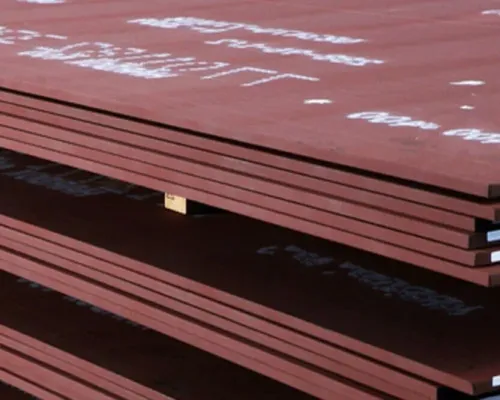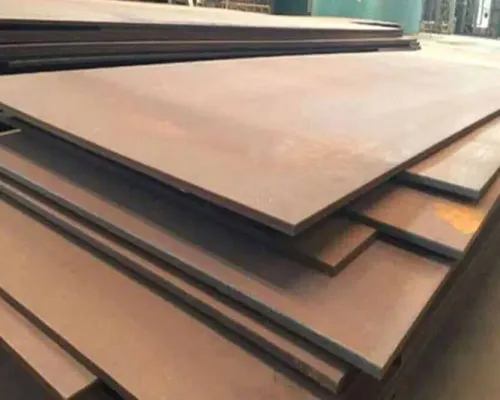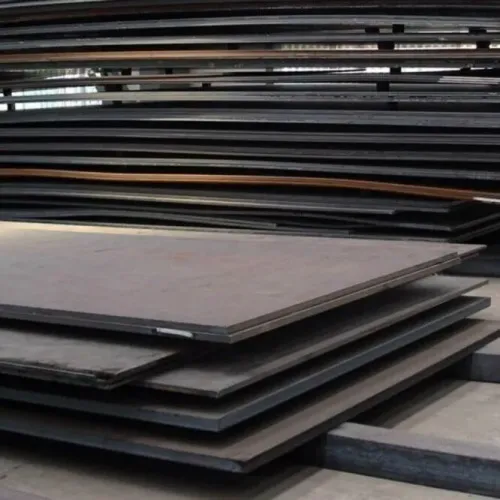
A 500-BHN label does not by itself show that a liner will survive a hopper, chute, feeder or dump body. You need to match the plate to the wear mechanism, impact and support conditions, then verify the grade, heat treatment, hardness, traceability and fabrication controls before ordering.
Key takeaways
- Match plate grade to sliding abrasion, gouging and impact conditions.
- Compare Abrex 400, 450 and 500 by wear demand, not hardness alone.
- Size thickness using load, support conditions and measured wear loss.
- Demand mill certificates, heat numbers and traceability before purchase.
Match Abrex 500 to the Wear Mechanism in Your Equipment
Abrex 500 suits equipment where sliding abrasion or gouging removes steel faster than impact can crack it. That includes hoppers, chutes, liners, dump bodies, feeder plates, screens, conveyor transfer points and some crusher components, but hardness alone cannot predict service life.
| Wear mechanism | What to inspect | Abrex 500 fit |
|---|---|---|
| Sliding abrasion | Long scratches, uniform thinning and extended contact distance | Strong candidate |
| Impact | Dents, craters, cracks and plate bending | Check toughness, support and temperature first |
| Gouging | Deep furrows from large angular rock | Suitable when impact is controlled |
| Material-on-material wear | Polished contact bands and local metal transfer | Compare contact pressure and alignment |
| Combined wear | Thinning beside dents, cracks or gouges | Design the attachment and backing, not just the grade |
Quartz-rich ore cuts differently from rounded coal; larger, sharper particles increase gouging, while moisture changes flow and can reduce or increase sliding. Feed size, drop height, loading direction and sliding distance matter. A hard plate can fail early under severe impact, bending, cold conditions, loose fasteners, gaps or poor backing.
- Mark where the plate thins, dents, cracks, gouges or loosens.
- Record feed size, drop height and tonnes handled.
- Check continuous support, bolt tightness, weld restraint and edge gaps.
- Compare millimetres lost per month with the planned replacement interval.
If local damage dominates, redesign support before upgrading hardness.
Choose Between Abrex 400, 450 and 500 Without Chasing Hardness
The 500 in Abrex 500 describes an approximate Brinell hardness class, not a 500 MPa yield-strength grade. Choose it for severe sliding or gouging wear only when the equipment can tolerate harder fabrication and lower impact tolerance.
| Plate class | Main advantage | Choose it when | Main compromise |
|---|---|---|---|
| Abrex 400 | Better impact tolerance and easier fabrication | Impact, bending, low temperature or frequent repair dominates | Faster wear under severe sliding |
| Abrex 450 | Balanced wear resistance and toughness | You need a middle position between service life and workshop effort | Neither the easiest nor the hardest option |
| Abrex 500 | Highest wear resistance in this range | Sliding abrasion and gouging control the failure | More demanding cutting, drilling, bending and welding |
A harder plate does not guarantee longer life. A 500-class liner can crack under impact, resist bending poorly or become costly to repair, while Abrex 400 or 450 survives because it absorbs shock and fits the structure.
Select the lower class when complex fabrication, cold service, thin unsupported areas or repeated modification outweigh maximum abrasion resistance.
Before comparing an Abrex 500 plates India offer with another wear resistant plates supplier India, request:
- The manufacturer’s stated hardness range, not only “500 BHN”
- Hardness test method, such as HBW to ISO 6506-1 or ASTM E10
- Test location, plate thickness covered and certificate heat number
- The original mill grade designation and delivery condition
Treat hardness claims without those details as incomplete. The certificate must show what was tested and where.
Select Plate Thickness From Loading, Support and Measured Wear
Choose thickness from impact and support, not from a catalogue habit. Feed size, drop height and impact energy set the bending and shock demand; abrasive mass, loading pattern and measured wear set the material-loss demand. Unsupported span, backing plate, fastening layout and liner access decide whether that thickness survives installation.
| Option | Support and attachment | Likely result |
|---|---|---|
| Thinner hard plate | Continuous backing, close fasteners, no gaps | Can outlast a thicker plate by resisting movement and edge impact |
| Thicker plate | Unsupported span, loose bolts or restrained welds | Can crack, dish, loosen or concentrate loads at edges |
| Either thickness | Correct support and accessible replacement joints | Selection depends on measured wear and shutdown interval |
A wear resistant plates supplier india should help verify usable dimensions, bolt clearance and replacement-piece access, not only quote thickness. Avoid gaps: impact loads concentrated at an unsupported edge can damage the plate and its backing.
Use this replacement calculation:
- Measure the existing plate at several locations and record the thinnest reading.
- Separate uniform thinning from local gouging, dents or edge loss; do not average away a gouge.
- Establish the minimum safe remaining thickness from structural loading, support and attachment.
- Calculate wear allowance as millimetres lost per operating hour or tonne handled, multiplied by the time or tonnage until the planned shutdown.
- Add that allowance to the safe remaining thickness, then check bolt access, weld restraint and lifting space before ordering.
If the result cannot be installed without forcing the plate against restrained welds or leaving unsupported areas, redesign the support rather than simply adding thickness.
Specify the Mill Certificate and Traceability Before You Buy
A price per tonne proves little unless the purchase order ties the plate to its original mill grade and heat.
ABREX 500 is a proprietary designation, not a generic Indian or international standard, so an abre x 500 plates india search should end with a named mill grade, heat number, dimensions, delivery condition and certificate type.
Require an MTC covering:
- Chemical composition, specified mechanical properties, hardness range and test method, plate identification, heat-treatment condition, and the applicable mill specification or product standard.
- For N or Q+T material, the delivered condition plus the mill’s heat-treatment notation or process record.
- Dimensional tolerances, flatness, surface condition, cut-piece tolerances, marking, packing, permitted weld repair and ultrasonic testing when required.
- Any Charpy impact requirement, including test temperature and method.
Compare supply formats by documentation and usable yield, not nominal weight alone.
| Supply option | Check before approval | Cost or risk |
|---|---|---|
| Full mill plate | Visible heat marking, complete parent-plate certificate, cropped ends and dimensional tolerance | Higher yield if your nesting is efficient |
| Locally cut piece | Parent-plate certificate coverage, heat visibility, kerf, cut-edge condition and cut tolerance | Less fabrication work but reduced usable area |
| Imported surplus | Original documents, mixed heats, remaining dimensions, lead time and replacement availability | Attractive price can disappear through delay or poor yield |
Ask an ABREX 500 plates stockist in India or ABREX 500 plates supplier in India whether each piece is original mill production, surplus or locally cut. Shyam Metals & Alloys is one source to question about original mill supply, cut-to-size traceability and matching replacement pieces.
Related product
 | Resistant Plates Abrex (400 / 450 / 500 ) Item Abrasion Resistant Plate Material Abrex 400 /450 /500 /600 Thickness 6mm to 100mm Width 1,500mm to 2,500mm Length... View product → |
Control Cutting, Welding, Bending and Machining of Abrex 500
Treat Abrex 500 as quenched-and-tempered wear steel, not ordinary mild steel. The mill’s cutting and welding instructions take priority because workshop heat can change hardness, toughness and liner life.
- Cut with a controlled procedure. Thermal cutting can leave hardened or softened edge zones and can initiate cracks in thick or highly restrained plate. Deburr edges destined for welding or cyclic loading, then inspect them for cracks or follow the mill’s specified edge treatment.
- Weld clean, dry joints with low-hydrogen consumables. Control consumable storage, hydrogen exposure, joint restraint, plate thickness, carbon equivalent, ambient temperature, preheat and interpass temperature; do not select preheat from hardness alone. Do not specify post-weld heating or stress relieving without the mill’s instruction.
- Cold-bend only to the mill’s grade- and thickness-specific minimum inside radius. An ordinary mild-steel radius can cause edge or transverse cracking, especially after flame cutting or when edges remain sharp.
- Machine with rigid workholding, positive support, carbide or other wear-resistant tooling, conservative parameters and continuous cuts. Avoid interrupted cuts and obtain production settings from the mill or tooling supplier.
Before commissioning, check cut edges for cracks, welds for cracking, fasteners for looseness and liners for unsupported areas. Ask an Abrex 500 plates supplier in India or a wear resistant plates supplier India for the applicable fabrication procedure before work begins.
Frequently asked questions
Which wear mechanisms suit Abrex 500 plates?
Abrex 500 suits sliding abrasion and gouging in equipment such as hoppers, chutes, liners, dump bodies and transfer points. Check impact, support and material flow before selecting it.
How do you choose between Abrex 400, 450 and 500?
Compare the actual wear mechanism, impact exposure, fabrication needs and expected service life instead of choosing solely by hardness.
How should you select Abrex 500 plate thickness?
Use loading, support spacing, impact conditions and measured wear loss to select thickness. A thicker plate cannot correct inadequate support or severe local impact.
What documents should you request when buying Abrex 500 plates in India?
Request the mill test certificate, grade and thickness details, heat number, plate identification and delivery traceability records before accepting the material.
What fabrication controls apply to Abrex 500?
Follow the producer's documented limits for cutting, preheating, welding, bending and machining, and record heat input and consumables during fabrication.