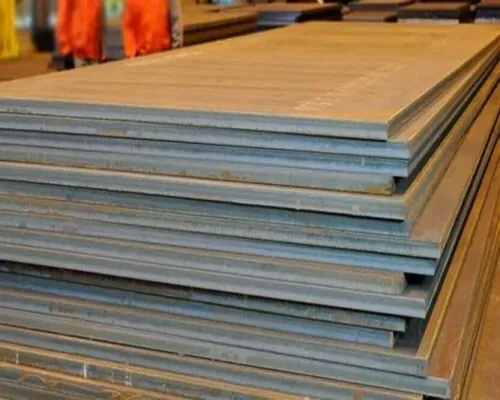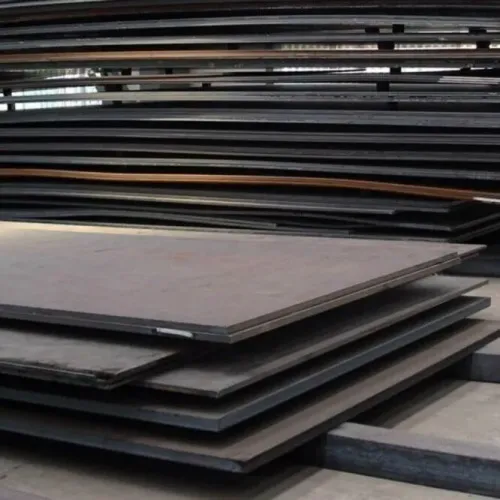
Hardox 400 is a wear plate, not a universal oil-and-gas equipment steel. By separating abrasion duty from pressure containment, checking the governing code, and verifying the original mill documents, you can decide whether the branded plate fits your component and compare offers without confusing 400 HBW with a complete material specification.
Key takeaways
- Treat 400 as a hardness class, not a guaranteed 400 HBW reading.
- Match Hardox 400 to abrasive wear, not pressure containment alone.
- Control cutting, welding and bending to preserve wear performance.
- Demand the exact designation, test certificate and heat-and-plate traceability.
What the 400 in Hardox 400 tells you—and what it does not
Hardox 400 is a branded quenched-and-tempered abrasion-resistant plate with a nominal hardness range of about 370–430 HBW. The number 400 describes a hardness class, not an exact 400 HBW result at every location. A quotation for “400 BHN plate” does not establish genuine Hardox 400; require the exact product designation and heat-and-plate traceability.
| Property | What it tells you | What it does not prove |
|---|---|---|
| Hardness, 370–430 HBW | Resistance to indentation and abrasive wear | Tensile strength, yield strength or fracture toughness |
| Tensile strength | Maximum pulling stress before failure | Resistance to sliding wear |
| Yield strength | Stress at which permanent deformation begins | Suitability for pressure containment |
| Fracture toughness | Resistance to crack growth under defined conditions | Corrosion resistance |
Hardox 400 suits sliding abrasion from sand, impact from rock or drilling cuttings, and erosion from high-velocity solids. It is therefore most defensible in replaceable liners, chutes, hoppers and other wear parts, not as an automatic pressure-boundary material.
Hardness provides no corrosion resistance and does not qualify the plate for a separator, pressure vessel or flowline.
A search for “hardox 400 resistant plates india” can return genuine branded plate, an equivalent wear grade or material described only by approximate hardness. Confirm the governing equipment specification before choosing. Wet, chloride or sour service needs a separate corrosion and materials review; hardness alone cannot establish safe service.
Where Hardox 400 fits in oil and gas equipment
Classify the part by function: Hardox 400 fits replaceable wear parts exposed to abrasive solids, not automatically the pressure boundary.
1. Use it as a candidate for chutes, liners, hoppers, skips, mud-handling equipment and solids-handling components carrying drilling mud, sand, cuttings or rock. Sliding abrasion, impact severity and high-velocity particle erosion matter more here than nominal hardness alone.
2. Treat separators, pressure vessels, flowlines, piping, valves and other pressure-retaining parts differently. ASME Section VIII, API 5L and API 5CT impose material, toughness, welding and traceability requirements that a wear-plate designation does not satisfy.
3. Before approving substitution, verify the governing equipment code, approved material list, design temperature, impact requirements, qualified welding procedure and owner or operator restrictions. A request to a Hardox 400 plates manufacturer in India should name the approved grade rather than accepting “400 BHN plate” or an unspecified equivalent.
4. Review the service environment separately. Hardox 400 is not stainless steel or a corrosion-resistant alloy; wet chloride exposure can cause corrosion, and hydrogen-sulfide service requires the applicable NACE MR0175/ISO 15156 or project review.
5. Confirm suitability from the actual particle type, impact load, operating temperature, structural load and plate support. A thin, poorly supported liner can deform or crack even when the wear mechanism matches the grade.
How Hardox 400 compares with other wear-plate choices
Ordinary structural steel is cheaper and easier to cut, drill, bend and weld, but severe sand or rock abrasion can wear it out sooner. Hardox 400 sits between low-cost fabrication and maximum hardness: it provides useful wear life without making every forming, machining and welding operation unusually demanding.
| Choice | Practical trade-off | What to verify |
|---|---|---|
| Ordinary structural steel | Lower material cost and easier fabrication; shorter life in severe abrasion | Grade, thickness, support and expected wear rate |
| Hardox 400 | Balanced abrasion resistance, impact toughness, bending, machining, welding and fabrication cost | Exact designation, HBW range, chemistry, thickness tolerances, toughness and mill documentation |
| Quard 400, JFE EH 400, Abrex 400 or Rockhard 400 | Quenched-and-tempered alternatives that are not automatically interchangeable with Hardox 400 | Product-specific chemistry, hardness range, impact toughness, tolerances and traceable documentation |
| Hardox 450 | Higher hardness can improve sliding-wear resistance; forming and machining require more force and control | Bending radius, tooling, welding procedure and cracking risk |
| Hardox 500 | Greater sliding-wear resistance in suitable service; higher fabrication difficulty and weld-procedure demands | Impact performance, temperature, support, heat input and hydrogen control |
A search for hardox 400 resistant plates india does not establish which product you are buying. Specify the required HBW range, thickness, impact performance, service temperature, abrasive material and corrosion exposure, then name the approved brand or grade and permitted substitutions.
Hardness alone cannot predict life where impact, wet chlorides or sour service control the failure.
Fabrication controls that protect the plate’s wear performance
Resolve fabrication controls before the plate enters the workshop. Ask the producer for its thickness-specific preheat and interpass-temperature table, then reject a fixed rule such as “always preheat to 150°C”; the correct range depends on thickness, process and heat-affected-zone limits.
1. For welding, control hydrogen exposure, heat input, consumable storage and restraint. Select compatible low-hydrogen consumables. Use a qualified WPS and supporting PQR for critical components and for joints between Hardox 400 and carbon or low-alloy structural steel.
2. Inspect the heat-affected zone as a wear-performance issue, not only a weld-strength issue. Excessive heat can soften the plate, reduce abrasion resistance beside the joint and increase distortion; trapped hydrogen can cause delayed cracking after fabrication.
3. Follow the producer’s thermal-cutting guidance and define acceptance requirements before cutting. Confirm whether the project requires cut-edge hardness testing, edge preparation, repair-welding controls or dimensional inspection. An overheated edge can become the failure line in a liner.
4. For drilling and machining, use tooling, cutting speeds, feeds and cooling methods intended for hardened plate. Ordinary mild-steel settings can quickly damage tools or overheat the workpiece.
5. For cold forming, check thickness, rolling direction, minimum inside radius and press-brake force. A narrow strip concentrates strain, while a small radius can crack genuine Hardox 400; increasing force after cracking has begun will not repair the damage.
How to verify a Hardox 400 offer from an Indian manufacturer or supplier
Verify the chain of custody, not just the hardness. Ask whether the hardox 400 plates supplier in india is the original plate manufacturer, a stockholder or a distributor, where the plate was produced, and whether its documents trace to the original heat and plate.
| Seller status | What to confirm | Evidence |
|---|---|---|
| Original manufacturer | Production site and branded product designation | Original mill certificate and heat records |
| Stockholder | Source mill, receipt identity and stored plate markings | Mill certificate matched to heat and plate number |
| Distributor | Upstream seller and document continuity | Unbroken document trail to the producing mill |
Inspect the original mill test certificate for:
- Exact Hardox 400 designation, heat number, plate number and thickness
- Chemical analysis, hardness results, delivery condition and applicable standard
- Plate dimensions, tolerances and certificate type
Request an EN 10204 inspection document 3.1 when the project requires that traceability, then match its heat number with the stamp, stencil or tag on the plate. A hardness test alone does not prove genuine branded material.
For hardox plates in bengaluru, state thickness, width, length, quantity, cut size, delivery point, MTC or inspection-document requirements, and whether cut edges require inspection or machining. Shyam Metals & Alloys is a usable Bengaluru sourcing option only when its quotation identifies the original producer and supplies documents accepted by your project.
Name the approved brand or grade, hardness range, testing requirements and permitted substitutions in the purchase order. Replace “400 BHN plate” with those exact controls.
Related products
 | Resistant Plates Hardox (400 / 450 / 500 ) Item Hardox Plate Material HARDOX 500/ 400/450/600 ,SUMIHARD ,NICRODUR,BRINAR ,DUROSTAT ,DILLIDUR ,JFE EVERHARD Thickness... View product → |
 | Hardox plate ₹170 Hardox plate is a high-strength, wear-resistant steel plate widely used in heavy-duty industrial applications. View product → |
Frequently asked questions
What does the 400 in Hardox 400 mean?
The 400 identifies a hardness class. Hardox 400 has a nominal hardness range of about 370–430 HBW, so it does not mean every location measures exactly 400 HBW.
Where does Hardox 400 fit in oil and gas equipment?
It fits components exposed to abrasive service, such as wear liners, chutes, hoppers and material-handling parts. It is not a substitute for selecting pressure-containing material against the governing design code.
How should you compare Hardox 400 with other wear plates?
Compare the specified hardness range, impact toughness, thickness availability, weldability, bending limits, delivery documents and traceability—not only the hardness number.
How can you verify a Hardox 400 offer from an Indian supplier?
Ask for the exact product designation, manufacturer documentation, heat number, plate number, inspection or test certificate and matching markings on the plate. A quotation for “400 BHN plate” alone does not establish genuine Hardox 400.